
How Many Porta Potties Does Your Oklahoma Construction Site Need? (OSHA Calculator)
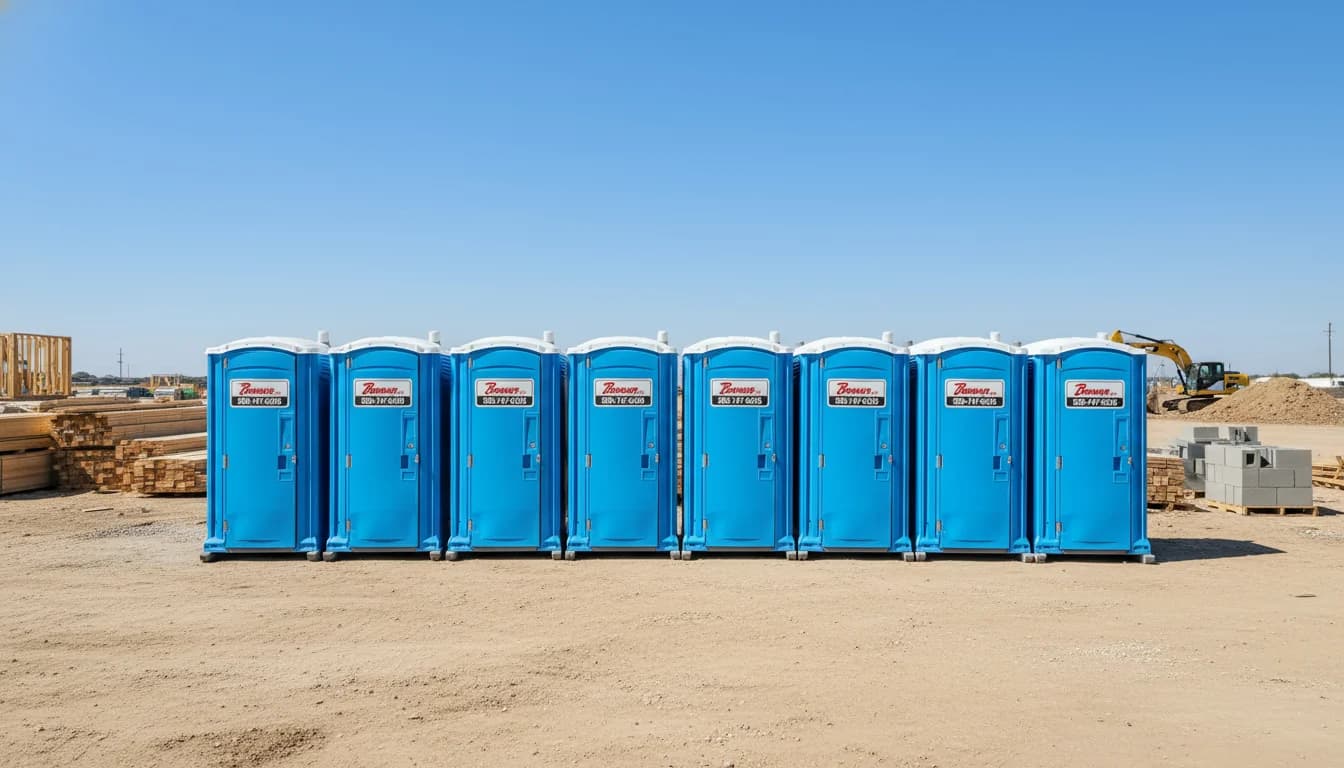
The fastest way to turn a profitable Oklahoma construction job into an OSHA citation is to under-count porta potties. The federal ratio under 29 CFR 1926.51(c) is not a suggestion — it is a hard minimum, and inspectors do count.
This guide gives you the exact unit count for any Oklahoma jobsite, the hand wash rules most contractors miss, ADA considerations, and shift-pattern adjustments — plus a pocket calculator you can use before you pick up the phone to book. Every number comes from the OSHA standard itself and from what Brower Inc. actually delivers to construction sites across Kay, Garfield, Kingfisher, and Sedgwick counties every week.
Quick Answer
For an Oklahoma construction site, OSHA 29 CFR 1926.51(c) requires 1 porta potty for 1-20 workers, 2 units for 21-200 workers, and 1 additional unit for every 40 workers above 200. A hand washing station is required alongside the toilets whenever toilet facilities are used. Add one ADA-accessible unit for crews with disabled workers.
Want us to run the numbers for your specific jobsite?
Tell us crew size, project length, and address. We'll return an OSHA-compliant unit plan and a flat monthly price in writing — usually within the hour.
Get Your Free Jobsite Plan →The OSHA Porta Potty Ratio at a Glance
OSHA's construction sanitation standard 29 CFR 1926.51(c) is what every Oklahoma general contractor is inspected against. It has three tiers based on the number of workers on-site per shift. Here is the exact language translated into a table you can screenshot for your project binder.
| Workers On-Site (Per Shift) | Minimum Porta Potties Required | OSHA Reference |
|---|---|---|
| 1-20 workers | 1 toilet | 1926.51(c)(1)(i) |
| 21-200 workers | 2 toilets (or 1 toilet + 1 urinal per 40 workers) | 1926.51(c)(1)(ii) |
| Over 200 workers | 1 toilet + 1 urinal per 40 workers | 1926.51(c)(1)(iii) |
The ratio counts workers per shift — not the total headcount across the day. A site with two shifts of 15 workers needs the 1-unit minimum, not 2 units.
Porta Potty Calculator by Crew Size (Oklahoma)
Skip the math. Here are the most common Oklahoma crew sizes we deliver for every week, with the OSHA-compliant unit count plus our recommended comfort-level count (which accounts for peak usage and Oklahoma summer heat).
| Crew Size | OSHA Minimum | Brower Comfort Plan | Hand Wash Stations |
|---|---|---|---|
| 1-10 workers | 1 | 1 | 1 |
| 11-20 workers | 1 | 2 | 1 |
| 21-40 workers | 2 | 3 | 1-2 |
| 41-80 workers | 2 | 4 | 2 |
| 81-160 workers | 2 | 5-6 | 3 |
| 161-200 workers | 2 | 7-8 | 4 |
| 240 workers | 3 | 8-9 | 4-5 |
| 400 workers | 5 | 12-14 | 6-7 |
The OSHA minimum is what keeps you legal. The Brower comfort plan is what keeps a crew from losing 15 minutes of productive time per worker per day standing in line — particularly during hot Oklahoma summers when hydration-driven restroom usage spikes.
Rule of Thumb
OSHA minimum + one extra unit per 25 workers above the minimum = a crew that never waits.
Under-counting causes productivity loss. Over-counting by one unit per 25 workers is usually worth it.
Hand Washing Stations: The Rule Most Contractors Miss
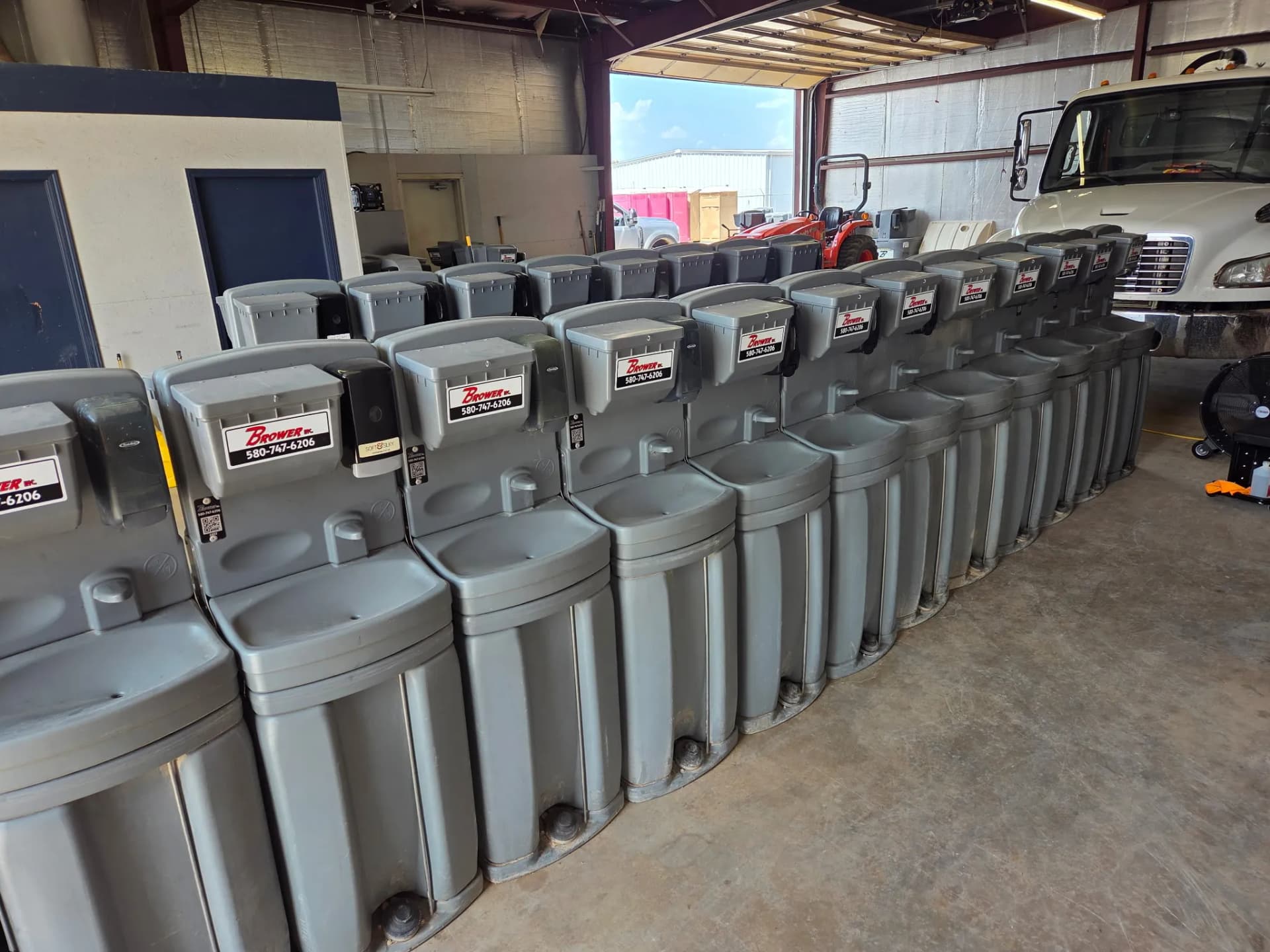
OSHA 29 CFR 1926.51(f) requires that an adequate supply of potable water be provided for drinking, washing, and food preparation on every construction site. In practice, that means every jobsite with porta potties also needs at least one hand washing station.
The Brower Inc. standard:
- 1 hand washing station per 2 porta potties as a starting ratio
- 1 station per 25 workers when food is consumed on-site
- Stations stocked with soap, potable water, and paper towels — refilled during weekly servicing
- No plumbing or hookups required — Brower's standalone units work on any Oklahoma jobsite
When You Need an ADA-Accessible Porta Potty
OSHA does not explicitly mandate ADA units on every construction site, but the Americans with Disabilities Act does require reasonable accommodation for covered employees — and sanitation is about as reasonable as accommodations get.
The Brower Inc. recommendation for Oklahoma general contractors:
- Crews with any ADA-qualifying worker: At least one ADA-accessible unit, full stop
- Public-facing construction zones (downtown buildouts, retail remodels): One ADA unit as a best practice even without a qualifying employee
- Large commercial projects (50+ workers): One ADA unit added by default to reduce discrimination-complaint exposure
ADA-compliant units typically cost 25-40% more than a standard blue Maxim 300 — about $175-$325/month in Oklahoma. We cover the cost comparison in detail in our Oklahoma porta potty rental cost guide.
Mixed crew? Let us build the plan for you.
Tell Troy your crew breakdown and we'll line up the exact right mix of standard units, ADA-accessible units, and hand wash stations — OSHA-compliant and fully serviced.
Call (580) 747-6206Multi-Shift, Night Work, and 24/7 Site Adjustments
The OSHA ratio is based on peak headcount per shift, which creates two pitfalls contractors fall into on multi-shift jobs.
Pitfall 1: Under-counting by splitting headcount across shifts
Two shifts of 25 workers each is not "a 50-person site" for OSHA purposes. It is two back-to-back 25-person sites, and two units would satisfy 1926.51(c). The risk is productivity, not compliance.
Pitfall 2: Under-servicing by ignoring usage doubling
A 2-unit site with 25 workers using them for 8 hours gets serviced weekly. A 2-unit site with 50 workers across two shifts using them for 16+ hours generates double the waste volume — and needs 2-3 services per week to stay sanitary.
Brower Inc. prices multi-shift and 24/7 sites accordingly. We will quote the realistic service schedule up front so the contractor is not forced to choose between a higher bill and a non-compliant unit.
Night-shift lighting
For sites running past sundown (oil and gas work, emergency infrastructure, highway overnights), we add solar-powered LED lighting to each unit as a safety measure — no hookups, no generators, no trip hazard complaints.
Oklahoma-Specific Considerations
The federal OSHA standard is the same everywhere, but how you meet it on an Oklahoma jobsite has a few local twists.
Heat and ventilation
Oklahoma summers regularly exceed 100°F. A standard Maxim 300 porta potty has a tall vent stack that pulls hot interior air upward — but neglected units become unusable at peak heat. Weekly (or better, twice-weekly) servicing is not a luxury in July in Ponca City. It is the difference between a compliant unit and a de facto non-compliant one.
Wind and tip-over risk
Oklahoma is a top-ten windiest state. Units placed on open jobsites — particularly in Kay, Woods, and Kingfisher counties — should be strapped or weighted during storm season (March-June). Brower Inc. secures every unit at delivery as standard practice.
Rural access and delivery
Many Oklahoma jobsites — particularly oil pads, wind-farm construction, and agricultural infrastructure — sit on gravel section-line roads well off the highway. National chains routinely refuse these deliveries. Brower Inc. makes them every day. If you're unsure whether a rural address is serviceable, call and we'll tell you on the spot.
Real Oklahoma Jobsite Examples
These are anonymized versions of actual Brower Inc. jobsite deployments from the past 12 months.
Example 1: 14-person residential build — Ponca City
A 9-month custom home build with a core crew of 14 framers, electricians, and plumbers. OSHA minimum: 1 unit. Brower plan: 1 standard porta potty + 1 hand washing station, serviced weekly. Total monthly cost: about $250 all-in.
Example 2: 45-person commercial remodel — Enid
A 4-month retail buildout with 45 workers across one shift. OSHA minimum: 2 units. Brower plan: 3 standard units + 1 ADA-accessible unit + 2 hand wash stations, serviced twice-weekly during drywall/paint phases. Total monthly cost: about $925 all-in.
Example 3: 120-person infrastructure project — Wichita, KS
A highway-expansion project with 120 workers across two shifts (75 day / 45 night). OSHA minimum: 2 units. Brower plan: 5 standard units + 1 ADA-accessible unit + 3 hand wash stations + overnight LED lighting package, serviced 3x per week. Total monthly cost: about $1,900 all-in.
Example 4: 22-worker oil and gas crew — Woods County
A 24/7 drilling operation with 22 workers rotating across three shifts. OSHA minimum for peak-shift headcount: 2 units. Brower plan: 2 standard units + 1 hand wash station, serviced 3x per week because of round-the-clock usage. Total monthly cost: about $725 all-in with remote-access surcharge.
"Brower Inc. delivered everything we needed for our Oklahoma commercial project. Quick response, clean equipment, and they actually knew the OSHA ratios better than my site super."
— Sarah Henderson, Project Manager | Enid, OK
5 Compliance Mistakes to Avoid
- Counting total headcount instead of per-shift. The OSHA ratio is based on peak workers on-site per shift. Over-counting is expensive; under-counting is a citation.
- Forgetting the hand washing station requirement. A site with porta potties and no hand wash station is two violations, not one.
- Placing units more than a "reasonable walking distance" from the work area. OSHA interprets this as within 200 feet in most cases — park units close to where the crew actually works.
- Skipping weekly servicing to save money. An un-serviced unit can be cited as a non-compliant facility regardless of whether the correct number was rented.
- Assuming a provider's contract covers everything. National chains often bill servicing, delivery, and pickup separately. Ask for an all-in written quote — the way Brower long-term rentals are structured by default.

Why we quote OSHA plans, not rentals
"A contractor shouldn't have to memorize 29 CFR 1926.51 to rent a porta potty. Tell me your crew size and project length and I'll tell you what OSHA requires, what keeps your guys from standing in line, and what it costs. One phone call, one written quote."
— Troy Brower, Owner | Newkirk, Oklahoma
Get an OSHA-compliant jobsite plan in writing.
Tell us crew size, project length, and address. We'll spec the exact unit count, hand wash stations, and service schedule — then quote one flat monthly price.
Frequently Asked Questions: Porta Potty Requirements on Oklahoma Construction Sites
One standard porta potty is the OSHA minimum for a crew of 1-20 workers under 29 CFR 1926.51(c). Brower Inc. recommends pairing that single unit with a hand washing station to stay compliant with the OSHA sanitation requirement, and upgrading to two units if workers are on-site longer than 8 hours per shift.
Related Brower Inc. resources