
Does Your Oklahoma Jobsite Need an ADA Portable Restroom?
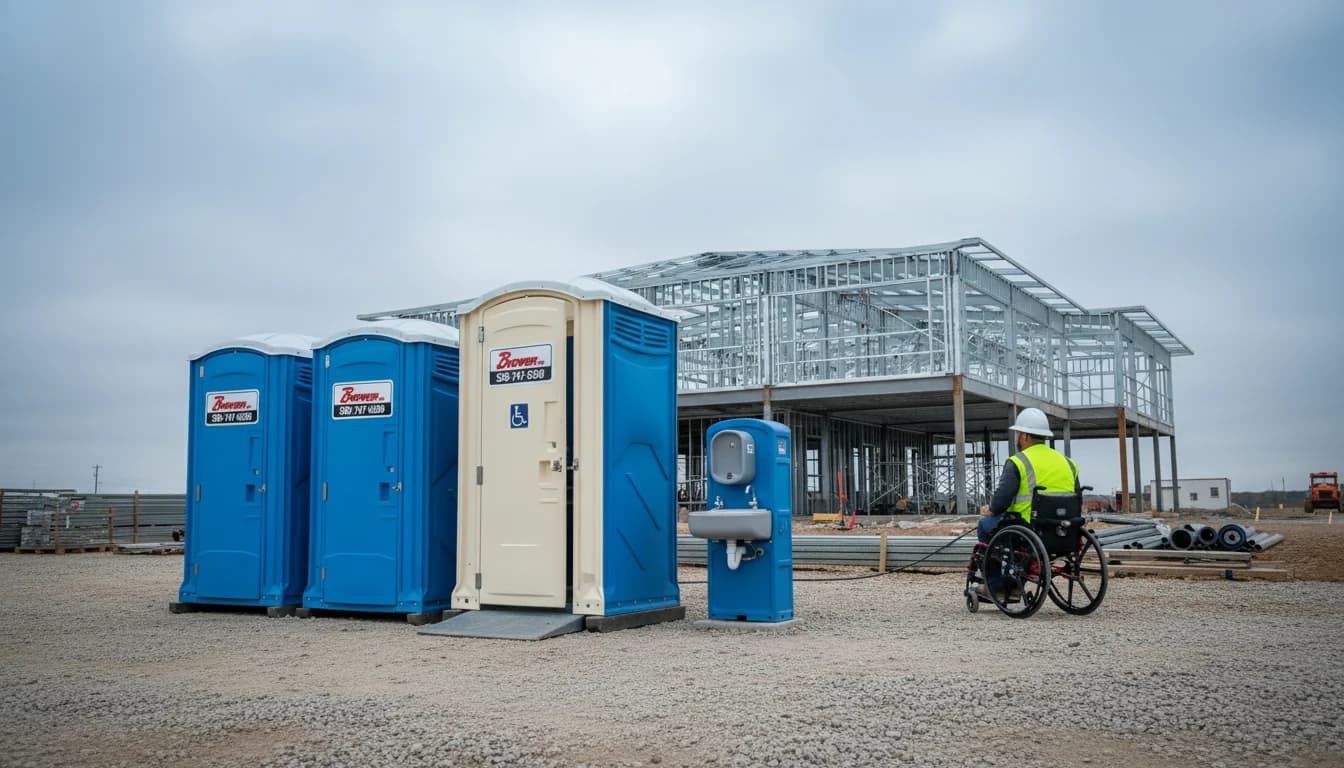
Of the 1,247 OSHA citations issued under 29 CFR 1926.51 against U.S. construction employers in 2024, more than a thirdinvolved sanitation facilities that "could not be used by all employees on the site." Translation: somebody on that crew couldn't physically get into the porta potty — and the GC found out the hard way.
The question every Oklahoma general contractor eventually has to answer is the same one buried inside that citation language: does my jobsite need an ADA portable restroom? The good news is that the rules are not ambiguous. This guide walks through the OSHA standard, the ADA layer most contractors miss, the decision tree for "do I need one," the real 2026 Oklahoma price, and the five mistakes that turn a $50/month add-on into a five-figure exposure.
Quick Answer
Yes for almost every active Oklahoma construction site. OSHA requires sanitation facilities every employee can use, and the ADA requires accessible facilities anywhere your site is open to the public. The defensible baseline is one ADA-accessible portable restroom per cluster of standard units, paired with an accessible hand washing station. In Oklahoma, that's typically a $40–$75/month premium over a standard unit — far cheaper than the citation if you skip it.
Need an ADA unit on site this week?
Brower Inc. dispatches ADA-accessible portable restrooms 24/7 across north-central Oklahoma and southern Kansas — usually same-day or next-day from our 640-unit fleet in Newkirk. We'll add it to your existing order or set up a fresh cluster from scratch.
See ADA Unit Specs & Pricing →The Law: OSHA + ADA, Translated
Two federal frameworks govern accessible restrooms on Oklahoma jobsites. They overlap, but they answer different questions, and most enforcement actions cite both.
OSHA 29 CFR 1926.51 — Sanitation
OSHA's construction sanitation standard requires "an adequate number of toilets in compliance with Table D-1" and that those facilities be sanitary and usable by all employees. The word "usable" is the hinge. If a worker on your site uses a wheelchair, a walker, crutches, or has any mobility limitation that prevents them from stepping up into a standard porta potty, the unit on site is not "usable by all employees," and the citation writes itself.
ADA Titles I and III — Accessibility
Title I of the Americans with Disabilities Act requires employers with 15+ employees to provide reasonable accommodations — and access to a usable restroom is the textbook example. Title III covers public accommodations: jobsite trailers used as sales offices, construction tours, and any portion of an active site open to the public must include an accessible restroom under the 2010 ADA Standards for Accessible Design.
Where Oklahoma Adds Its Own Layer
Oklahoma operates under federal OSHA jurisdiction for private-sector construction (state-plan coverage applies only to public-sector workers via Oklahoma OSHA). For practical purposes on commercial and residential jobsites across Kay, Garfield, Kingfisher, Logan, and the other counties we serve, the federal standard above is the standard that applies.
What Actually Makes a Unit "ADA-Compliant"
"ADA-compliant" in portable sanitation is not a vibe — it is four physical specs. A unit either meets them or it does not.
| Spec | ADA Requirement | Standard Porta Potty |
|---|---|---|
| Entry height | Zero-step, ground-level | 4–6 in. step up |
| Door clear width | ≥ 32 in. | ~22 in. |
| Interior turning radius | ≥ 60 in. | ~38 in. |
| Grab bars | Required, both sides of seat | None |
Brower Inc.'s ADA-accessible portable restrooms meet all four specs. From the outside, you can tell ours apart from a standard unit by the wider cream-and-blue cabin and the ramped, zero-step entry on the front face — no step, no curb.
Decision Tree: When You Need an ADA Unit
Work through these in order. The first "yes" settles the question.
- Is any worker on your site (employee or sub) using a wheelchair, walker, crutches, or otherwise has a mobility limitation that prevents them from stepping up into a standard unit? → Yes. You need an ADA unit. Today.
- Is the site open to the public for tours, sales walks, model-home access, or any pedestrian path through? → Yes. ADA Title III applies, and an accessible restroom is required.
- Do you employ 15 or more people and have any possibility of an accommodation request? → Yes. Title I makes the unit a reasonable accommodation; budget for it now.
- Is the site near a public sidewalk, transit stop, or used as a path of travel by neighborhood residents? → Yes. An accessible facility is the safe default.
- None of the above? → You may not be required to provide one today, but you are one phone call from being required. Most GCs across our service area add an ADA unit from day one because the alternative is rebooking mid-project.
Stop guessing. Get a unit count and ADA recommendation in writing.
Tell us your crew size, project length, and address. We'll send back the OSHA-compliant unit count, whether you need an ADA unit, and an all-in flat quote — usually within the hour.
Call (580) 747-6206How Many ADA Units Do You Need?
OSHA's Table D-1 sets the worker-to-toilet ratio. The ADA layer says at least one of those toilets, in each cluster, must be accessible.
| Workers | OSHA-required toilets | Recommended ADA units |
|---|---|---|
| ≤ 20 | 1 | 1 ADA (replaces the standard unit) |
| 21–40 | 2 | 1 ADA + 1 standard |
| 41–80 | 2–3 (per Table D-1) | 1 ADA + 2 standard |
| 80–200 | 5 | 1 ADA per cluster + remainder standard |
| 200+ | 1 per 40 workers | ≥ 1 ADA per cluster across the site |
For the full ratio breakdown, run your crew through our Oklahoma porta potty calculator first, then add the ADA layer on top.
Whose Responsibility Is It?
On a multi-employer Oklahoma jobsite, OSHA assigns sanitation compliance to the controlling employer— functionally, the general contractor. That responsibility persists even when the worker who needs the accessible unit is a subcontractor's employee. The GC's sanitation contract is also the document an OSHA inspector asks for first.
"On our commercial jobs in Kay and Garfield counties we spec the ADA unit on day one. If a sub shows up with a guy in a wheelchair on week six, the unit's already there. We've never had a citation because the call happens before the inspector does."
— Troy Brower, Owner | Brower Inc. | Newkirk, OK
What It Costs to Rent in Oklahoma
An ADA-accessible portable restroom in Oklahoma typically rents for $175 to $275 per month with weekly servicing included — a $40–$75 premium over a standard blue unit. The premium comes from three things: the unit itself is more expensive to build, it takes more space on the truck, and ADA stock per route is lower so the routing cost is higher.
| Unit Type | Typical OK Rate (long-term) | Weekly Service |
|---|---|---|
| Standard porta potty | $125–$200/mo | Included |
| ADA-accessible porta potty | $175–$275/mo | Included |
| Hand washing station | $90–$140/mo | Included |
Compare that to the OSHA serious-violation penalty ceiling of $16,131 per violation in 2026, per the federal OSHA penalty schedule, and the math is not close. For more on hidden line items in rental quotes, see our breakdown of what a porta potty rental really costs in Oklahoma.
Where to Place the ADA Unit on Site
Placement matters as much as having the unit at all. The ADA standard implies a usable path of travel— a unit on the back of a muddy berm a worker can't reach is not an accessible facility. The basics:
- Level, compacted, hard surface — gravel pad or concrete, never bare dirt that turns to mud.
- Clear approach — 60 inches of unobstructed approach in front of the door, no parked equipment.
- Co-located with the standard cluster — not isolated 200 yards away. Same trailer, same sanitizer station, same servicing schedule.
- Lit at night — porch lights or unit-mounted LED on any site with second-shift work.
- Adjacent to an accessible hand washing station — same path, same surface.
5 Mistakes That Get Oklahoma GCs Cited
- "We'll add it if we need it." The day you need it, you needed it yesterday. The citation lands the same day the worker shows up.
- Treating "handicap" and "ADA" as interchangeable. Some vendors stock a wider unit they call "handicap" that still has a step. If the door is 32" wide but the entry is curbed, the unit is not ADA-compliant.
- Skipping the accessible hand wash.The OSHA inspector reads the cluster as one system. A wheelchair- accessible toilet next to a basin a wheelchair user can't reach is not a compliant cluster.
- Placing the unit on uneven ground. A unit on a slope or soft dirt is unusable. The whole cluster fails.
- Letting the standard servicing skip the ADA unit. The ADA unit needs the same weekly empty, restock, and inspection. If your provider treats it as a "special unit" with extra fees per service, you have the wrong provider.
How Brower Inc. Handles ADA Orders
We'll be straight: we built our ADA process around the mistakes above. Here is what an ADA order looks like in practice from our Newkirk yard:
- Quoted in writing, all-in flat rate, with the ADA unit on its own line so the GC can show the cost in the project ledger.
- Delivered on a level, compacted pad we will spec on the call if your site needs site prep.
- Paired with an ADA-compatible hand washing station on the same delivery.
- Serviced weekly on the same route as your standard units — empty, restock, sanitize, inspect, log.
- Documented in a servicing log you can hand an OSHA inspector without going to look for it.
- Backed by 24/7 dispatch across our 20-county service area — if you need a same-day add-on because a worker started this morning, we move on it.
For the broader compliance picture, pair this with our OSHA portable restroom requirements checklist and the 10-point provider checklist so the vendor on your site can actually back any of the above up.
Get an ADA unit on your Oklahoma jobsite — usually same or next day.
Tell us your address, crew size, and project length. We'll quote an all-in flat rate with the ADA unit, hand washing station, and weekly servicing on one line — and dispatch from our Newkirk fleet. Call (580) 747-6206 or send us the details and we'll write it up.
Frequently Asked Questions
It depends on two things: who is on your site, and whether the site is open to the public. Under OSHA 29 CFR 1926.51, every covered employer must provide sanitary facilities all employees can actually use — which means an ADA-accessible unit whenever you have, or could reasonably have, a worker with a mobility disability. Under Title III of the ADA, jobsite trailers, sales centers, and any portion of the site open to the public must include accessible restroom facilities. The safest default on any active Oklahoma jobsite is to include at least one ADA unit per cluster of standard porta potties.
The ADA Unit Is the Cheapest Compliance Insurance You'll Buy
A standard porta potty plus an ADA-accessible unit plus a hand washing station, all on one weekly route, is a sub-$500/month line item on a six- or seven-figure job. The OSHA citation, the disability-discrimination complaint, the lost day while someone scrambles to source a unit from a different vendor — those are the expensive paths. The ADA unit is the cheap one.
Brower Inc. is locally owned in Newkirk, runs a 640+ unit fleet that includes ADA-accessible portable restrooms, includes weekly servicing on every long-term rental, and dispatches 24/7. Call (580) 747-6206 or request a flat-rate quote with the ADA unit on its own line.
Related reading
Related guides
Our services
Service areas