
OSHA Portable Restroom Requirements: The Oklahoma Construction Compliance Checklist
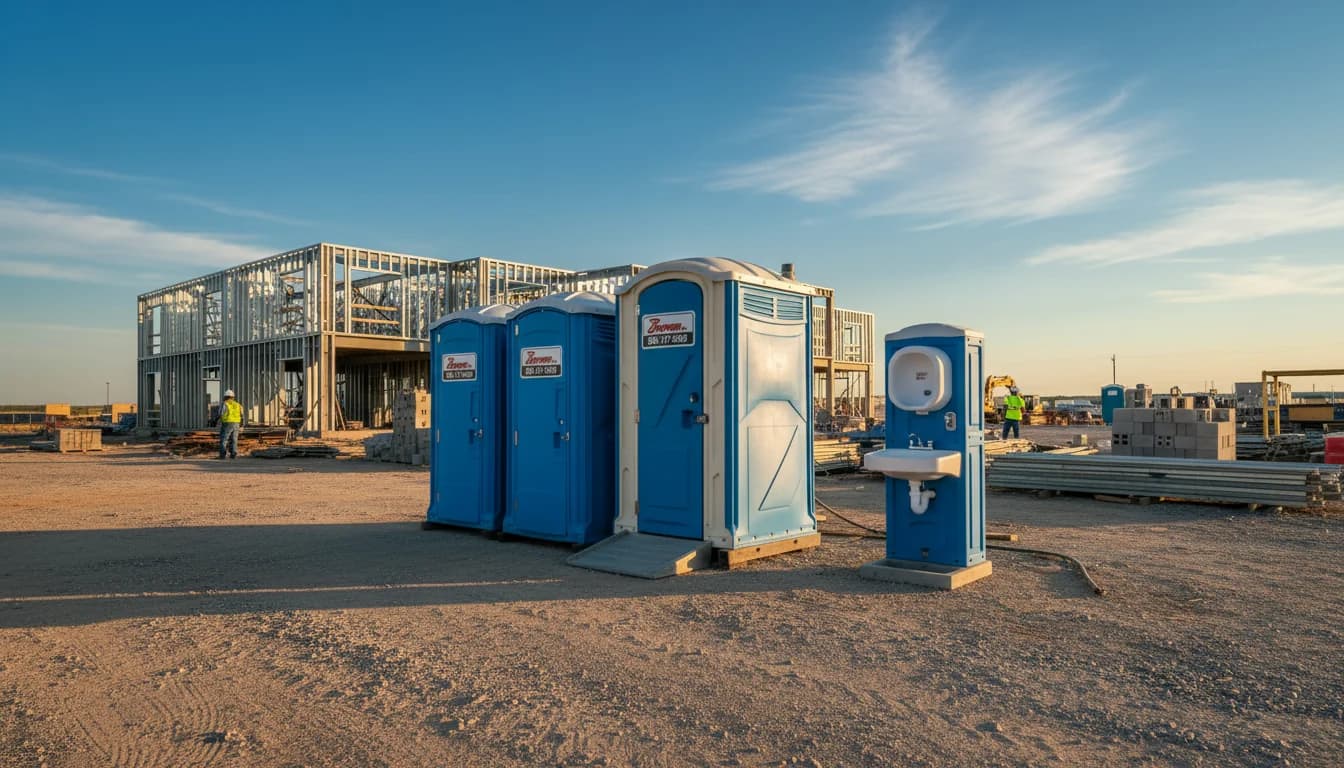
An OSHA compliance officer can shut down a $4 million Oklahoma construction project before lunch over a problem that costs $200 a month to fix. The problem is portable restrooms — wrong count, wrong cleanliness, no hand wash, no ADA unit. Inspectors look at sanitation first because it's easy to count and impossible to hide.
This is the print-ready compliance checklist Brower Inc. uses with every Oklahoma general contractor we deliver to — from a 5-worker remodel in Newkirk to a 240-worker pipeline project in Kay County. Every line item maps back to the federal standard 29 CFR 1926.51 and is what we've seen federal area offices in Oklahoma City, Tulsa, and Wichita actually cite over the last decade.
Quick Answer
Every Oklahoma construction site must provide at least 1 portable toilet per 20 workers on shift (under 29 CFR 1926.51(c)(1)), a separate hand washing facility, accessible ADA units when applicable, and weekly servicing at minimum. Federal OSHA enforces the standard in Oklahoma and Kansas. Fines run up to $16,131 per serious violation in 2026 — each missing or unsanitary unit can be cited separately.
Need a compliant porta potty plan for your Oklahoma jobsite?
Send us your crew size and address. We'll return an OSHA-compliant unit plan with weekly servicing, hand wash, and an ADA unit if you need one — flat-rate, in writing, usually within the hour.
Get Your Free Compliance Plan →Who Enforces OSHA in Oklahoma & Kansas
Many states run their own OSHA-approved plans (California, Oregon, Washington, etc.). Oklahoma does not — and neither does Kansas for private-sector construction. That means every private-sector construction site in Brower Inc.'s 20-county service area is inspected against the federal 29 CFR 1926.51 standard, by a federal OSHA compliance officer dispatched out of one of three area offices:
- Oklahoma City Area Office — covers most of north-central, central, and western Oklahoma (Kay, Garfield, Noble, Payne, Logan, Kingfisher, Woods counties and others)
- Tulsa Area Office — covers eastern Oklahoma
- Wichita Area Office — covers all of Kansas including Sedgwick, Sumner, Cowley, Butler, Harper, Kingman counties
There is no Oklahoma-specific version of the rule, no relaxed variation for rural sites, and no leeway for short-duration projects. The standard applies identically to a 2-day reroof in Ponca City and a 9-month commercial build in Wichita.
The 10-Point OSHA Portable Restroom Compliance Checklist
Print this page or screenshot the checklist below. Every line is what an OSHA compliance officer looks for when they roll up unannounced to your Oklahoma jobsite. If you can answer yes to all ten, you are defensibly compliant.
| # | Compliance Item | Standard |
|---|---|---|
| 1 | Correct unit count for peak shift headcount | 1926.51(c)(1) |
| 2 | Weekly servicing minimum (more if usage warrants) | 1926.51(c)(4) |
| 3 | Hand washing facility provided | 1926.51(f) & 1910.141 |
| 4 | ADA-accessible unit when needed | ADA Title I + OSHA general duty |
| 5 | Sex-separated or unisex single-occupancy units | 1926.51(c)(3) |
| 6 | Readily accessible placement (≈ 10-min walk) | 1926.51(c)(1) interpretive |
| 7 | Working door with privacy latch | 1926.51(c)(3) |
| 8 | Adequate for Oklahoma weather (anchored, shaded if possible, frost protection in winter) | General duty clause |
| 9 | Servicing log + delivery records on file | Recordkeeping best practice |
| 10 | Emergency / same-day replacement plan with provider | Contract best practice |
1. Unit Count & Ratio (29 CFR 1926.51(c)(1))
The single most-cited line of the construction sanitation standard is the toilet-to-worker ratio. The OSHA table is short:
| Workers Per Shift | Minimum Toilets | Reference |
|---|---|---|
| 1–20 | 1 toilet | 1926.51(c)(1)(i) |
| 21–200 | 1 toilet seat + 1 urinal per 40 workers | 1926.51(c)(1)(ii) |
| 200+ | 1 toilet seat + 1 urinal per 50 workers | 1926.51(c)(1)(iii) |
Two things contractors get wrong on the ratio:
- Counting total headcount instead of peak shift. A site running two shifts of 25 needs the 21–200 tier (2 toilets) — not the 50-worker tier — because peak shift is 25, not the combined 50.
- Forgetting subcontractors.If your crew is 18 but the electrician's crew of 6 is on site the same day, your peak is 24 — you're in the 21–200 tier. The GC is responsible.
For a deeper walkthrough with crew-size scenarios, see our Oklahoma porta potty calculator.
2. Servicing & Cleanliness (29 CFR 1926.51(c)(4))
OSHA does not put a specific number on servicing frequency, but the standard requires that toilet facilities be maintained in a sanitary condition. In practice, that means:
- Weekly servicing minimumfor any standard construction crew — Brower Inc.'s default for all long-term rentals.
- Twice weekly for crews of 40+, 12-hour shifts, or 24/7 oilfield operations.
- Same-day response for any tipped, vandalized, or storm-damaged unit. (Brower Inc. dispatches 24/7 across all 20 counties.)
- Restock paper, hand sanitizer, and paper towels every service.
- Scrub interior surfaces, deodorize, inspect for damage on every service.
The clearest signal a porta potty is notbeing properly serviced is the smell. Inspectors don't need a swab kit — they can tell from 20 feet away. That's why we publish our 7-step service protocol in our cleanliness deep-dive.
3. Hand Washing Facilities (29 CFR 1926.51(f))
This is the line that most often surprises Oklahoma contractors during their first inspection. Hand sanitizer alone does not satisfy OSHA hand washing requirements on sites where workers handle lead, paint, asbestos, or materials that contact food. Those sites require potable water + soap.
For everything else — typical framing, roofing, concrete, sitework — sanitizer inside the porta potty plus a paired hand washing station is the defensible standard. The hand washing station doesn't need a plumbing hookup; a foot-pump portable hand wash unit qualifies. Brower Inc.'s hand washing stations come fully stocked with water, soap, and paper towels and require no electricity or water connection.
Brower rule of thumb: One hand wash station per four porta potties, two per four if the site has 40+ workers or handles food.
4. ADA Accessibility
OSHA itself does not name a specific ADA standard for portable toilets — but the Americans with Disabilities Act Title I obligates every covered employer to provide reasonable accommodation. When a worker with a mobility disability is on your site, you owe them an ADA-accessible portable restroom — period. Failing to provide one is an ADA discrimination violation, separate from OSHA enforcement.
Because subcontractor crews rotate weekly on most Oklahoma jobsites, the defensible practice is to add at least one ADA-accessible unit to any site of 20+ workers. The cost difference is minimal, it eliminates last-minute scrambling, and the larger interior also doubles as the de facto family-friendly unit for any public-facing site (open house, model home, public-works project).
5. Sex Separation (29 CFR 1926.51(c)(3))
When both men and women work the site, OSHA requires separate facilities — unless the units are single-occupancy with lockable doors. Almost every standard porta potty qualifies as single-occupancy unisex, which is why most Oklahoma sites can run a single combined unit count rather than doubling up by sex.
The exception is multi-stall trailer units (rare on construction sites). If you ever upgrade to a multi-stall trailer for a long-duration project, designate it as men's or women's with signage and add a single-occupancy unit for the other sex.
6. Placement & Accessibility
The standard says "readily accessible." OSHA's interpretive guidance — and what every inspector applies in practice — translates to roughly a 10-minute walk from any active work area. For a small site this is automatic; for a sprawling site like a 40-acre solar build or a 4-block pipeline run, it means staging units in multiple locations.
Placement rules of thumb:
- Level, well-drained ground.
- Away from crane swing paths and equipment lanes. A tipped unit is an immediate citation and a sanitation hazard.
- Within sight of break areas — workers actually use units they can see.
- In Oklahoma summer, avoid full-day direct sun if possible. Heat accelerates odor and tank-pressure issues.
- Cluster at site entrances or break trailers for high-visibility handwashing pairing.
7. Privacy, Doors & Locks
Every unit must have a working door, a privacy latch, and walls tall enough to provide reasonable privacy. Broken doors and non-functional latches are cited as routinely as missing units — don't assume your provider checks during weekly service. Brower Inc.'s service protocol explicitly inspects the door, hinges, latch, and roof on every visit.
8. Weather & Oklahoma Site Conditions
Oklahoma weather puts construction sanitation under unique stress. The general duty clause requires employers to provide facilities that are usable in conditions that occur — which in Oklahoma means:
- Wind anchoring. 50+ mph straight-line winds and derechos hit Oklahoma every year. Unanchored units blow over. Brower Inc. uses ground anchors or sandbag systems on any site exposed to open terrain.
- Summer heat. 100°F+ summers spike usage (more hydration) and accelerate odor. Sites running through July / August often need a service-frequency bump to twice weekly.
- Winter freeze. December / January nighttime temps below 20°F can freeze waste tank chemistry. Winter additives in the holding tank prevent this — Brower Inc. switches over in November.
- Tornado & ice storm recovery. When a tornado or ice storm hits, sites need emergency same-day replacement of damaged units. We dispatch 24/7 for storm response.
9. Documentation & Servicing Logs
Compliance is what you can prove. When an OSHA officer asks how often the unit is serviced, "weekly" is not a defense — the log is. Keep on file:
- The signed service contract showing unit type, count, and frequency.
- The weekly servicing log (date, technician, items restocked).
- The delivery receipt with date and address.
- Photos at install showing placement, signage, and ADA unit (if applicable).
- Any storm-response service tickets.
Brower Inc. provides every long-term construction client with a digital servicing log accessible at any time — you can email the link straight to an inspector.
10. Emergency & Same-Day Coverage
A unit can be compliant on Monday and a citation on Tuesday. A tipped trailer, a vandalized door, a tornado-damaged stall — any of these turn your site non-compliant within hours. The defensible answer is a provider who will dispatch same-day:
- 24/7 dispatch. A real person picks up day or night.
- Same-day replacement within the 20-county service area.
- Fleet stored locally — not routed from out-of-state on a 2-day truck schedule.
Call (580) 747-6206 at any hour. Trucks move toward the site within the hour.
2026 Federal OSHA Fine Schedule for Sanitation Violations
OSHA penalties are inflation-adjusted every January. The 2026 maximums for portable restroom violations under 29 CFR 1926.51 are:
| Violation Type | 2026 Maximum Per Violation |
|---|---|
| Other-than-serious | $16,131 |
| Serious | $16,131 |
| Failure to abate | $16,131 per day |
| Willful or repeated | $161,323 |
The headline figure is misleading. Each missing or unsanitary unit can be cited as a separate violation, which is why an under-supplied site can rack up multiple citations in a single inspection. A 60-worker site running zero porta potties has been cited for upwards of $48,000 in a single visit.
5 Mistakes That Actually Trigger Oklahoma OSHA Citations
From a decade of delivering to Oklahoma and Kansas jobsites, here are the five missteps we see most often — every one avoidable.
- Under-counting the peak shift. GC books for their own 15-worker crew, then the framer and electrician bring 10 more bodies on Tuesday. The peak is 25, the count is wrong, the citation is written.
- Hand sanitizer-only on a lead-paint site. Demolition, repaint, or historic-building work that disturbs lead requires water-and-soap hand washing. Sanitizer is not a substitute and inspectors know it.
- Letting servicing slip from weekly to biweekly to "whenever." Cost-cutting on service is the fastest path to a citation. Inspectors smell unmaintained units from the gate.
- No ADA unit when a sub brings a worker with a wheelchair. Subcontractor crews change weekly. The GC is responsible. Default to one ADA on every site of 20+ to eliminate the scramble.
- Unanchored units on a windy site. A toppled unit is a sanitation hazard, a worker safety hazard, and an obvious citation. Brower Inc. anchors every unit placed in open terrain.
Real Oklahoma Jobsite Examples
Three real-world Brower Inc. deployment scenarios — composite examples from actual Oklahoma construction projects we serve every week.
Example A — 12-Worker Kay County Remodel
Setup: 1 standard porta potty + 1 paired hand washing station, weekly servicing. Why: 1–20 tier requires 1 toilet; hand wash is best practice; weekly is the minimum cadence. Add ADA if: any worker uses a wheelchair, or the project is public-facing (open house pre-sale, etc.).
Example B — 50-Worker Wichita Commercial Build (Sedgwick County, KS)
Setup: 2 standard porta potties + 1 ADA-accessible unit + 2 hand washing stations, weekly servicing. Why: 21–200 tier requires 2 toilets; we add the ADA proactively for sub crews; one hand wash per 4 units is minimum, and we bump to 2 for the 50-worker shift comfort.
Example C — 240-Worker Pipeline / Solar Build, Western Oklahoma
Setup: 6 standard porta potties + 1 ADA + 3 hand washing stations, twice-weekly servicing, wind-anchored, distributed across the 4-mile right-of-way in 2 clusters. Why: Above 200 tier is 1 toilet per 50; peak shift drives the count; the distributed placement keeps every worker within the 10-minute walk OSHA interpretive guidance requires.
Stop guessing at OSHA compliance.
Tell us your crew size, project length, and address. We'll send back an OSHA-compliant porta potty plan — unit count, ADA, hand wash, and weekly servicing — flat-rate and in writing, usually within the hour. Call (580) 747-6206 or use the form.
Frequently Asked Questions
Federal OSHA applies. Oklahoma does not run a state-approved OSHA plan for private-sector construction, which means every Oklahoma jobsite — from Newkirk to Wichita — is inspected against federal 29 CFR 1926.51 exactly as written. Kansas private-sector sites fall under federal OSHA for the same reason. The only difference between Oklahoma and other states is which area office handles the inspection.
Compliance Is Easier When You Don't Have to Think About It
The OSHA portable restroom standard is short, specific, and easy to follow once you know what inspectors look for. The hard part is keeping every line on this checklist green for 6, 12, or 18 months of an active build — through weather, subcontractor turnover, crew expansions, and storm seasons.
That's the job Brower Inc. does for Oklahoma and southern Kansas general contractors every week. Locally owned in Newkirk, 1,375+ unit fleet stored on-site, 24/7 dispatch, and a servicing log every inspector accepts. Call (580) 747-6206 or request a free compliance plan and you'll have a flat-rate proposal in writing — usually within the hour.
Related reading
Related guides
Our services
Service areas