
Your Crew Stopped Drinking Water to Avoid the Porta Potty. In 105° Heat, That's a Safety Problem.
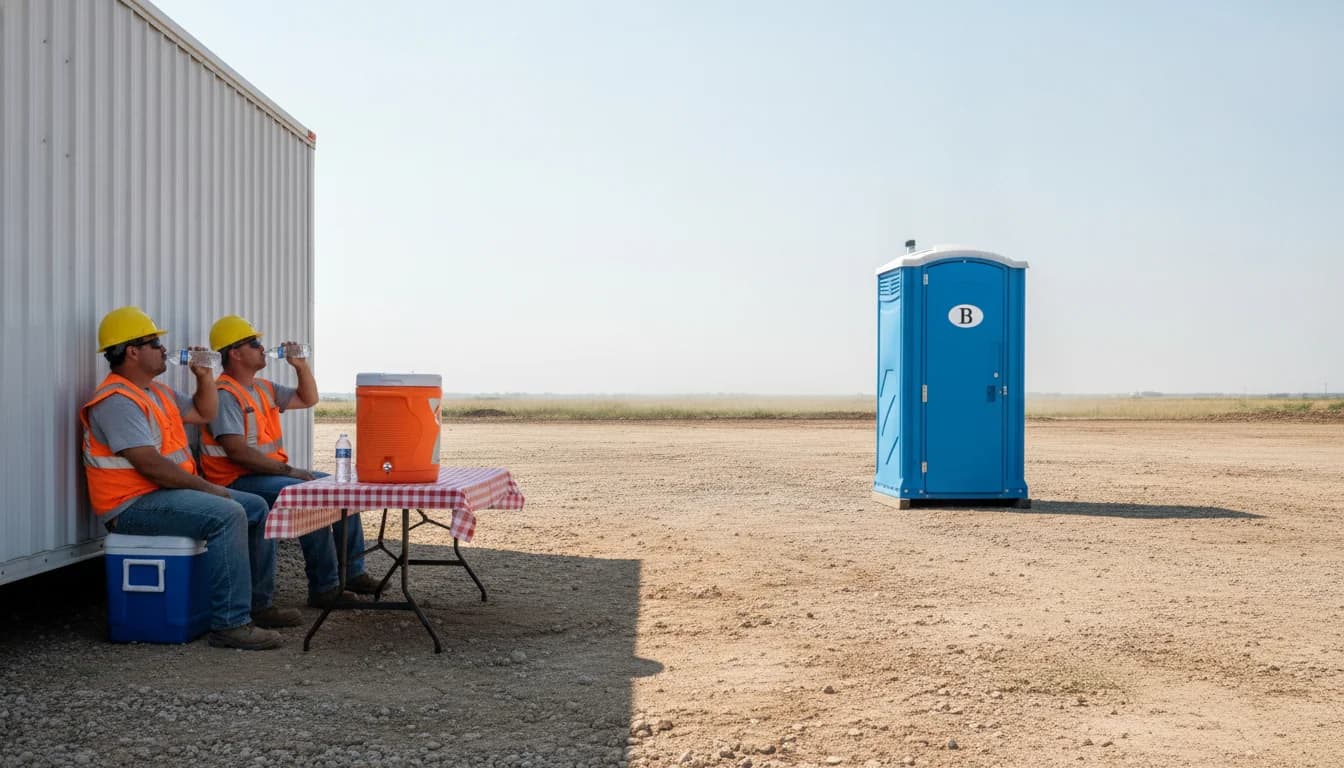
Nobody on your crew is going to walk up and say "I've stopped drinking water because the toilet is disgusting."What you see instead is quieter: the cooler barely goes down all afternoon, two guys are making a long run to the gas station mid-morning, and somebody who's been fine all season gets dizzy at 3pm and has to sit in a truck with the A/C running.
Those things are connected, and the connection is one almost nobody in this industry writes about. A restroom bad enough that people avoid it doesn't just cost you comfort and billable minutes — in an Oklahoma July it quietly pushes your crew toward dehydration, which is the front end of heat illness. This post lays out what's actually documented, what OSHA can and can't cite you for in 2026 (there's a lot of bad information going around), and what the fix actually costs.
Quick Answer
Workers in heat-exposed trades ration fluids when restrooms are inadequate — it's documented in survey and peer-reviewed research, and the downstream risk in a 105°F Oklahoma heat index is heat illness. On the compliance side, the federal heat standard is not final— it's still a proposed rule, with a final version projected no earlier than October 2027. What isenforceable today is OSHA's heat National Emphasis Program, renewed April 10, 2026 for five years, plus the General Duty Clause and the sanitation rule at 29 CFR 1926.51 — under which a toilet in an unsanitary condition counts as not provided at all.
Unit bad enough that your guys are driving off-site?
Brower Inc. sets service frequency to your headcount and the forecast, restocks every visit, and documents each stop — locally owned in Newkirk, real person on the phone.
See Long-Term Jobsite Rentals →What Actually Happens on Site
The behavior chain is simple and it runs the same way on almost every site. The unit gets unpleasant. People start putting off using it. Putting it off is easier if you're not drinking much. So the water intake drops — not as a decision anybody makes out loud, just as the path of least resistance. And in north-central Oklahoma in July, reduced fluid intake in direct sun is precisely the condition that produces heat exhaustion.
A worker on a building site in Leyton described the underlying problem about as plainly as it can be put:
"The portaloos are serviced once a week and they are OK for about two days before they become full and unusable."
— building site worker, via Hazards magazine
Two usable days out of seven. That's not a complaint about luxury — it's a description of a facility that exists on paper and not in practice for most of the week. And this is not an isolated gripe: a SafeWork SA audit of 168 building sites found 90 sites without clean, hygienic, convenient toilets, 13 with none at all, 39% not being regularly cleaned, and 64% with little to no soap. The regulator issued 103 improvement notices, and noted that 88% of the failures were on residential construction.
The Evidence That Workers Really Do Ration Water
We want to be careful here, because this is a place where it would be easy to overstate. There is no US construction-specific studyproving that American jobsite workers dehydrate themselves because of bad porta potties, and we're not going to pretend otherwise. What exists is consistent evidence of the same behavior across other heat-exposed and shift-based occupations:
- In the TUC's Toilets at Work survey of 4,126 workers, respondents described deliberately not drinking on shift because facilities were inadequate — one firefighter put it as "During a night shift I don't drink as I should as there's a great lack of facilities at an incident."
- A peer-reviewed study of 312 women workers in brick, steel, and agricultural work found 64% had no workplace toilet, and 87% of those reported genitourinary problems. Workers restricting fluids to under a litre per shift carried roughly four times the risk; lacking toilet access carried about six times the odds of urogenital issues.
- Heat is already the deadliest end of this. Of 986 occupational heat-related deaths recorded between 1992 and 2022, 334 — about 34% — were in construction. Oklahoma specifically recorded five construction heat fatalities between 2011 and 2023.
Read those together and the honest conclusion is not "bad toilets kill workers." It's narrower and more useful: restroom quality is a lever on hydration behavior, hydration behavior is a lever on heat illness, and construction is where heat kills most. If you're already running water, shade, and rest breaks — and you should be — a restroom your crew will actually walk into is part of the same system, not a separate comfort item.
What OSHA Actually Enforces on Heat in 2026
There is a great deal of confused information circulating about this, including from vendors who ought to know better. Here is the accurate picture as of July 2026.
The federal heat standard is not final
OSHA's Heat Injury and Illness Prevention rulemaking (RIN 1218-AD39) published as a proposed rule in August 2024. The comment period closed in January 2025 and the informal public hearing ran through July 2025. It remains at the proposed rule stage: the Unified Agenda projects a supplemental proposal around December 2026 and a final rule no earlier than October 2027. If a salesperson tells you that you must comply with a federal heat standard today, they are either mistaken or selling something.
For planning purposes, the proposal would trigger at an 80°F heat index— drinking water at one quart per employee per hour, paid rest breaks in cooled areas, and acclimatization for new workers' first week — with a 90°F high-heat trigger adding mandatory paid 15-minute breaks every two hours plus symptom monitoring. Those numbers may shift before anything is final, so treat them as a direction of travel rather than a checklist.
What is enforceable right now
- The heat National Emphasis Program. The prior NEP expired April 8, 2026 and OSHA replaced it almost immediately — the updated program took effect April 10, 2026, runs five years through 2031, and expands coverage to 55 high-risk industries, up from 33. Inspectors ask about heat programs on "heat priority days," defined as a heat index of 80°F or above.
- The General Duty Clause. With no specific heat standard, this is how OSHA cites serious heat hazards — and it applies in full here, because neither Oklahoma nor Kansas has a state heat standard. Only California, Oregon, Washington, Nevada, Colorado, and Maryland do.
- 29 CFR 1926.51 — sanitation. Covered in detail in the next section, and the part most directly in your control.
For context on why this matters locally: Oklahoma City recorded its hottest year on record through June 2026, and over the July 4th weekend the OKC forecast hit 101°F with a 105°F heat index, while Tulsa reached a 109°F heat index. Both sit well above the NEP's 80°F heat-priority threshold. On a day like that, an inspector walking your site is not a hypothetical.
Heat index over 80° and a unit nobody wants to open?
That's the combination that turns into a complaint. Brower Inc. runs documented summer routes across north-central Oklahoma and south-central Kansas and can step up your frequency this week.
Call (580) 747-6206Having Enough Units Doesn't Help If They're Filthy
This is the part contractors most often get wrong. The counts in 29 CFR 1926.51(c)(1) are straightforward:
- 20 or fewer employees — one toilet.
- More than 20 — one toilet seat and one urinal per 40 workers.
- 200 or more — one toilet seat and one urinal per 50 workers.
But hitting those numbers is only half the requirement. OSHA's own interpretation is that a toilet in an unsanitary conditionhas not been "provided" — meaning the right number of foul units can still be a violation. Condition is not a courtesy. It is part of the standard.
Two more things worth getting right, because competitor content routinely misstates both:
- 1926.51 sets no service frequency.It's a performance standard — the interval is whatever keeps the unit sanitary. Nobody can honestly tell you "OSHA requires weekly service," because it doesn't say that.
- Handwashing is not universally requiredon construction sites. The requirement at 1926.51(f) applies to employees applying paints, coatings, herbicides, or insecticides. It's still good practice everywhere — and in agriculture, 29 CFR 1928.110 does require toilets, potable water, and handwashing within a quarter-mile walk for employers of 11 or more hand-laborers, at one facility per 20 employees.
The frequently cited "one unit per 10 workers" figure comes from the ANSI/PSAI Z4.3 industry standard, not from OSHA — the two get blurred together constantly. If you want the counts worked out for your headcount, our OSHA porta potty calculator for Oklahoma jobsites runs the math, and our OSHA compliance checklist covers the rest of 1926.51.
The Fix Costs Less Than One Bad Afternoon
None of this requires a program or a consultant. It requires a unit people will walk into, in weather that makes that harder:
- Raise the service frequency for summer.Weekly is a fair-weather baseline. Busy sites, or anything above about ten workers, realistically want twice a week in July and August. We'll say plainly that this is our recommendation from running these routes — not a regulatory requirement.
- Put the unit in shade if you possibly can. Cooler interior, less odor, and a shorter walk means people actually use it instead of driving somewhere.
- Keep hand sanitizer out of direct sun. Alcohol sanitizer is meant to be stored roughly between 59°F and 86°F; heat drives off the alcohol and reduces its effectiveness. A bottle cooking on a sun-baked surface all afternoon is doing less than you think.
- Stock it like you mean it.Paper, soap or sanitizer, and a wiped seat on every visit. The SafeWork SA audit found 64% of sites with little to no soap — that's the detail that quietly tells a crew nobody is checking.
- Pair it with water and shade.The restroom is one leg of the hydration system. If the water is warm and the only shade is a truck cab, fixing the toilet alone won't change behavior.
"When a super calls me in July, nine times out of ten it isn't really about the toilet — it's that his guys are disappearing for twenty minutes at a time. You fix the unit and the trips to the gas station stop. That's the whole conversation."
— Troy Brower, Owner | Brower Inc. | Newkirk, OK
How Brower Inc. Handles Oklahoma Summer Jobsites
We've run portable restroom routes through north-central Oklahoma summers for decades, and we build the service around the conditions rather than a fixed calendar:
- Frequency set to headcount and forecast — twice-weekly or more on busy summer sites, not a national route schedule that never changes.
- Documented visits, so "did anybody actually come out?" stops being a question you have to argue about.
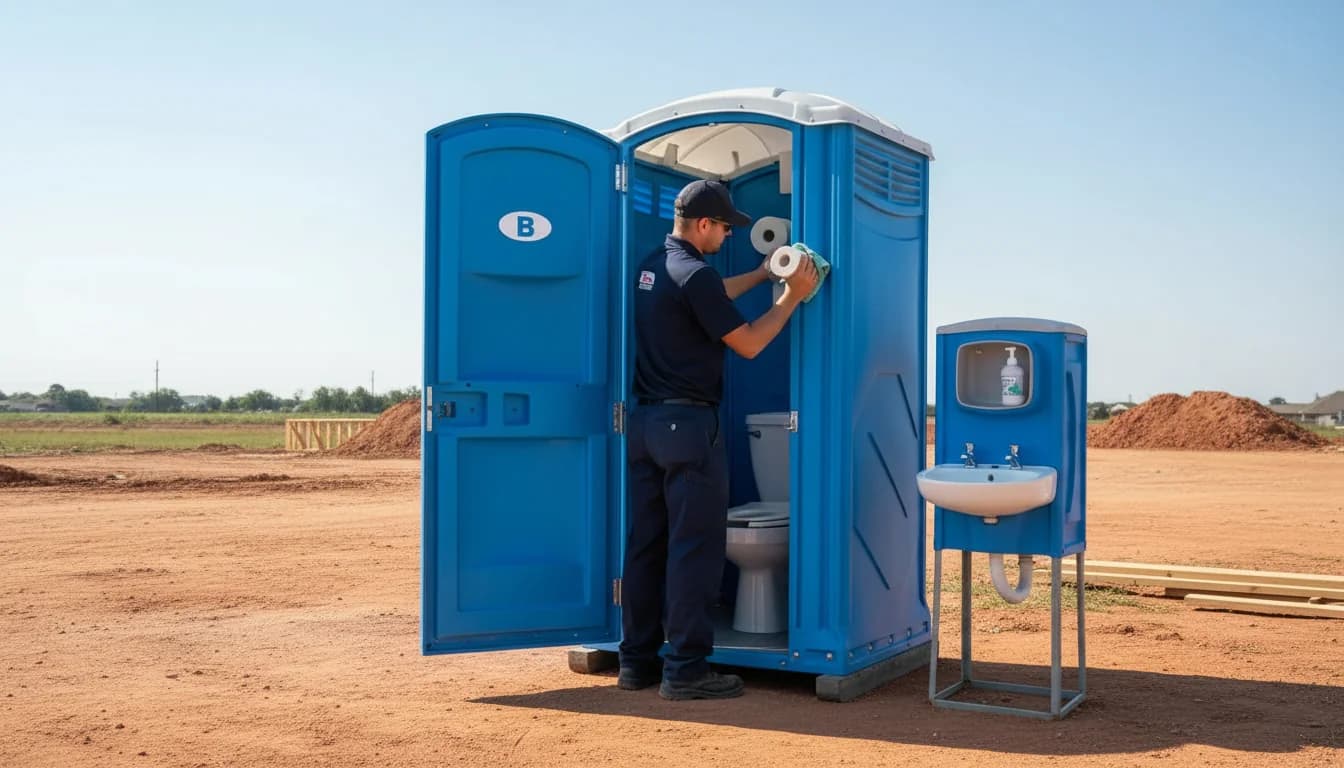
- Full pump, sanitize, and restock every stop — including paper and sanitizer, every time.
- Stocked hand washing stations where the work calls for them — required for some tasks, good practice for all of them.
- Placement advice built in — shade and airflow, and close enough that nobody rationalizes a drive.
- A real local number answered by someone who can add a visit this week, rather than a 1-800 queue and a next-business-day callback. We covered that gap in local vs. national providers.
Same standard whether it's a building site, an oilfield lease, or a summer event: a unit clean enough that your people will actually use it. If yours is already past that line, our guide to summer ammonia smell walks through diagnosing whether it's the heat or a provider stretching visits.
Get a jobsite restroom your crew will actually use this summer.
Tell us your site, headcount, and how long you'll be there, and we'll set a summer service frequency that keeps the unit sanitary and your crew drinking water. Call (580) 747-6206 or send the details for a quote.
Frequently Asked Questions
No — not a dedicated heat standard. As of July 2026 OSHA's Heat Injury and Illness Prevention rule (RIN 1218-AD39) is still at the proposed stage. The comment period closed in January 2025 and hearings wrapped in mid-2025, but the Unified Agenda projects a supplemental proposal in December 2026 and a final rule no earlier than October 2027. Anyone telling you a federal heat standard is in force today is wrong. What is enforceable right now is OSHA's National Emphasis Program on heat, renewed and expanded on April 10, 2026, plus the General Duty Clause — and neither Oklahoma nor Kansas has its own state heat standard, so federal enforcement applies directly.
A Restroom Nobody Will Use Isn't a Restroom
You can have the right number of units on site, current on the paperwork, and still have a sanitation problem — because the measure that matters is whether people will walk in. When they won't, they adapt in ways you don't see until somebody goes down at 3pm on a 105° day.
Brower Inc. is locally owned in Newkirk and services portable restrooms across 14 Oklahoma and 6 Kansas counties — summer frequency matched to your site, documented visits, and a real person on the phone. Call (580) 747-6206 or request a jobsite rental quote.
Related reading
Related guides
Service areas