
Emergency Portable Restroom Deployment in Oklahoma: Disaster Response Sanitation
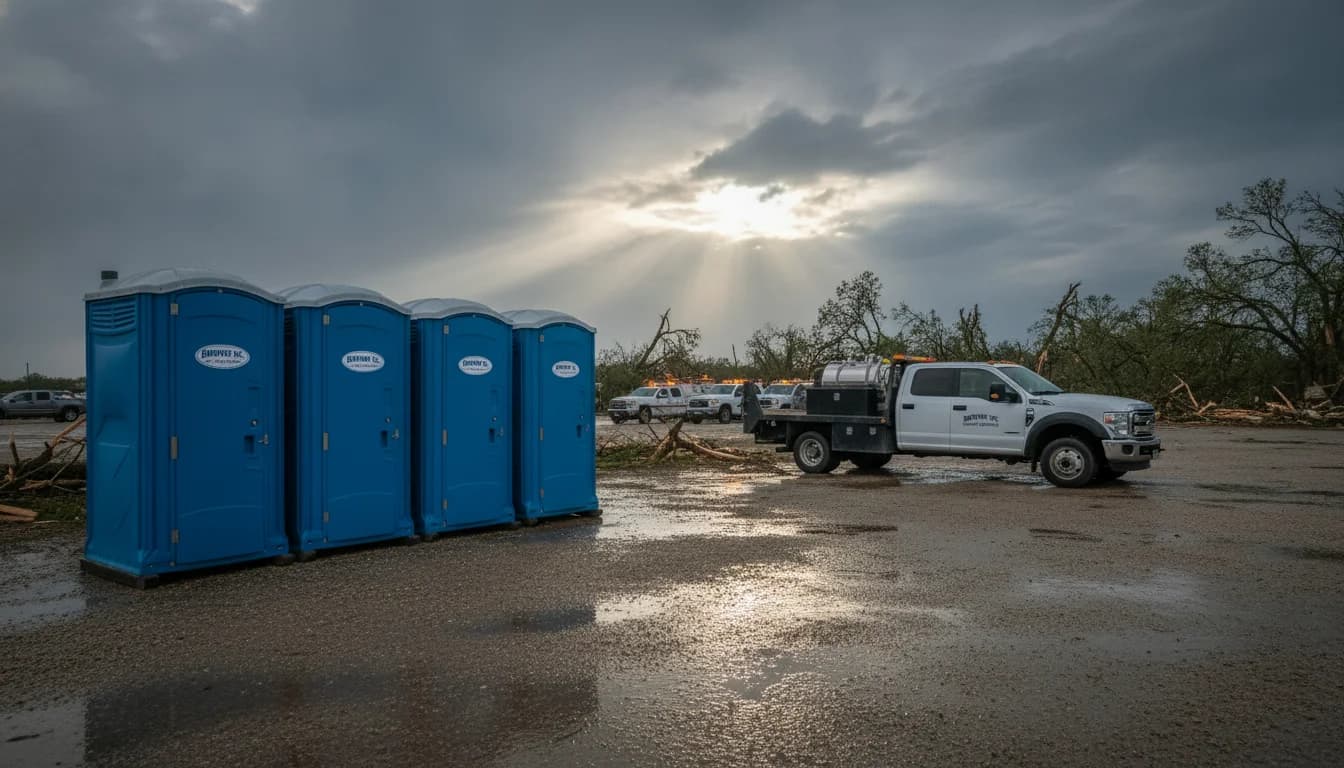
Oklahoma averages 56 tornadoes a year — and when one flattens a town or an ice storm snaps the power grid, the first thing that fails after the lights is the plumbing. Shelters fill, crews mobilize, and suddenly a few hundred people have nowhere sanitary to go. The single fastest piece of recovery infrastructure you can stand up is the one that needs no power and no water line: the emergency portable restroom.
This guide walks Oklahoma emergency managers, municipal buyers, and site leaders through exactly how disaster-response sanitation works — how fast units actually arrive, how many a shelter or staging area needs, the step-by-step deployment process, and the one move that separates organized response from chaos: arranging a standing agreement before the storm. Brower Inc. has run this playbook across 20 Oklahoma and southern Kansas counties, and every number below comes from how we actually mobilize.
Quick Answer
Emergency portable restrooms are the go-to disaster sanitation solution because they need no power and no water hookup. In Oklahoma, units from a locally stored fleet can be moving within the hour and on a staging area in a few hours, scaling to dozens over 24–48 hours. Plan roughly 1 toilet per 100 people per day, plus an ADA unit and a hand washing station per cluster. The biggest speed multiplier is a standing agreement arranged before storm season.
Need emergency sanitation right now?
Brower Inc. dispatches 24/7 across Oklahoma and southern Kansas. Call a real local crew day or night and we'll be moving toward your site within the hour.
Call 24/7: (580) 747-6206 →Why Oklahoma Needs a Disaster Sanitation Plan
Few states test emergency infrastructure like Oklahoma. According to the National Weather Service, Oklahoma averages dozens of tornadoes annually and ranks among the most tornado-prone states in the country. Layer on ice storms, flash flooding, and grass fires, and the state faces a grid-disrupting event somewhere nearly every season.
When disaster hits, sanitation is not a comfort issue — it's a public-health one. The CDC is explicit that safe human-waste disposal and handwashing are front-line defenses against disease outbreaks in the days after a disaster, when water systems may be compromised. A shelter without working restrooms becomes a secondary emergency within hours.
That's why portable restrooms and hand washing stations sit near the top of every serious continuity-of-operations plan. They're self-contained, they scale fast, and they keep working when the water main and the power grid don't.
When Emergency Portable Restrooms Are Needed
Disaster sanitation isn't only about tornadoes. Brower Inc. deploys emergency units across a wide range of urgent scenarios:
- Tornado recovery. Shelters, volunteer staging, debris-removal crews, and FEMA/insurance processing sites in the damage zone.
- Ice storm & grid failure.When power is out for days, warming centers and utility staging yards need facilities that don't depend on the grid.
- Flooding. When septic systems and sewer lift stations are underwater, portable units are the only safe option for affected neighborhoods.
- Residential plumbing or septic failure. A backed-up septic system or a burst main can make a home unusable until repairs are done.
- Utility & storm-restoration crews. Out-of-state line crews staging for days at substations and laydown yards.
- Last-minute event overflow. A festival or fair that drew double the expected crowd and needs units today.
The common thread: infrastructure has failed or been overwhelmed, and the need is measured in hours, not weeks. That's the exact job emergency and same-day porta potty rental is built for.
How Fast Units Can Actually Be Deployed
Speed in a disaster comes down to one thing: where the equipment already is. Brower Inc. stores a 1,375+ unit fleet locally in Newkirk and dispatches 24/7, which is what makes a realistic timeline look like this:
| Timeframe | What Happens |
|---|---|
| Within 1 hour | Call answered by a real local crew; first trucks loaded and moving toward the site. |
| First few hours | Initial wave of units placed at the primary staging area or shelter within the 20-county service area. |
| 24–48 hours | Deployment scales to dozens of units as equipment is freed and re-routed; servicing schedule established. |
| Ongoing | Twice-weekly (or daily) servicing for high-traffic sites; same-day swap of any damaged unit. |
A national chain routing equipment from a regional depot two states away simply can't compress that timeline — the trucks aren't in Oklahoma when the storm hits. Local storage is the whole game in disaster response.
How Many Units a Disaster Site Needs
Disaster sanitation planning uses a heavier ratio than a 4-hour event because sites run continuously and servicing access may be limited. A widely used baseline from portable-sanitation industry guidance is roughly 1 toilet per 100 people for 24-hour use, adjusted up for multi-day operations. Use this as a starting point:
| People on Site (24 hr) | Standard Units | ADA Units | Hand Wash Stations |
|---|---|---|---|
| Up to 100 | 1–2 | 1 | 1 |
| 300 | 3–4 | 1 | 1 |
| 500 | 5–6 | 1–2 | 2 |
| 1,000 | 10–12 | 2–3 | 3 |
Adjust up when servicing trucks can only reach the site infrequently, when usage is round-the-clock, or in summer heat that accelerates tank load. The safest move is to let us run the calculation against your real headcount and access constraints — over- or under-supplying a shelter both cause problems.
Need Emergency Sanitation? Call 24/7.
Tornado, ice storm, flood, or sudden failure — Brower Inc. mobilizes units across Oklahoma and southern Kansas around the clock. Call (580) 747-6206 and a real local crew starts moving toward your site within the hour.
The 5-Step Emergency Deployment Process
When you call during an emergency, here's exactly what happens on our end — and what we'll need from you to move fast.
- Call & rapid intake. A real person answers 24/7. We capture the essentials in under two minutes: location, approximate headcount, duration, site access, and any ADA needs.
- Site & access assessment. We confirm how trucks reach the site — blocked roads, soft ground, gate access — and choose placement points crews and residents can actually use.
- Dispatch & first wave. Units load immediately. The first cluster heads out while we line up the follow-on wave for larger deployments.
- Placement & setup. Units are positioned on stable ground, anchored if winds are a risk, paired with hand washing stations, and signed for accessibility.
- Servicing schedule. We set a servicing cadence up front — weekly, twice-weekly, or daily for heavy sites — and commit to same-day response for any damaged or overflowing unit.
Sanitation at Shelters & Staging Areas
Emergency shelters and staging areas have requirements a normal jobsite doesn't. A few non-negotiables we build into every disaster deployment:
- ADA accessibility. Public shelters must serve people with mobility disabilities. At least one ADA-accessible unit per cluster, with ground-level entry and interior handrails.
- Handwashing within reach. Per CDC guidance, handwashing is critical to preventing post-disaster disease. Station them beside the toilet clusters, not across the lot.
- Lighting & placement for safety.Place units where they're visible and reachable at night — shelters run 24/7, and people shouldn't cross a dark debris field to use a restroom.
- Wind anchoring.In Oklahoma's open terrain, units are anchored so a follow-on storm doesn't turn them into hazards.
For utility crews and contractors staging for storm restoration, the same principles apply with heavier servicing — see our disaster relief and utilities & telecom solutions.
For Cities, Counties & Emergency Managers
The single biggest predictor of a smooth disaster sanitation response is whether the agreement was set up before the disaster. Scrambling to issue a purchase order while a shelter overflows is the worst possible time to start a procurement process.
A standing emergency agreement with Brower Inc. puts the groundwork in place ahead of storm season:
- Pre-negotiated ratesso there's no pricing uncertainty mid-crisis.
- A defined first-wave unit count tied to your shelter and staging plans.
- Procurement documents on file — W-9, certificate of insurance, and formal quote — ready for public accountability.
- A single 24/7 contact so deployment begins with one phone call.
We work with municipal buyers across our region — see the government & municipal page for procurement details, or call (580) 747-6206 to put a plan on file for your emergency manager.
Oklahoma's Four Disaster Seasons
Disaster readiness in Oklahoma is a year-round posture because the threat changes with the calendar:
- Spring (tornado season). Peak severe-weather months. Shelters, debris crews, and recovery staging drive the heaviest emergency demand of the year.
- Summer (heat & grass fires). 100°F+ heat spikes usage and tank load; fire-staging areas need rapid facilities. Servicing frequency goes up.
- Fall (flooding & storms). Heavy rain events flood low-lying neighborhoods and overwhelm sewer and septic systems, stranding residents without working facilities.
- Winter (ice storms). Ice brings down power lines for days. Warming centers and out-of-state line crews stage at substations needing grid-independent sanitation — and tanks need winter additives to prevent freezing.
For the jobsite side of weather readiness, our OSHA construction compliance checklist covers wind anchoring, summer servicing, and winter freeze protection in detail.
Why Local Deployment Is Faster Than a National Chain
In a disaster, the difference between a local owner-operated provider and a national chain isn't branding — it's physics and phone lines:
- Equipment is already here. A 1,375+ unit fleet stored in Newkirk means trucks roll from inside the impact region, not from a depot two states away.
- A real person answers at 2 a.m. Owner Troy Brower and a local crew pick up around the clock — no call-center ticket queue during the exact hours disasters strike.
- Local road knowledge. We know which routes flood, which roads ice, and how to reach rural sites others won't attempt.
We dig into this trade-off in depth in our guide on local vs. national portable restroom providers.
Pre-Disaster Readiness Checklist
Whether you're a city emergency manager, a facility operator, or a contractor, run through this before the next storm season:
- Identify your shelter and staging sites and estimate peak headcount for each.
- Calculate first-wave unit counts using the 1 per 100 baseline, plus ADA and hand wash stations.
- Confirm site access — how trucks reach each site if roads are damaged or flooded.
- Set up a standing agreement with a 24/7 provider who stores equipment locally.
- File the paperwork now — W-9, insurance certificate, and rate sheet — so deployment is one phone call.
- Save the after-hours number in your continuity plan: (580) 747-6206.
Frequently Asked Questions
Because Brower Inc. stores its 1,375+ unit fleet locally in Newkirk and dispatches 24/7, trucks can be moving toward a site within the hour of your call. The first units typically reach staging areas in north-central Oklahoma and southern Kansas within a few hours, with larger multi-dozen deployments scaling over the following 24 to 48 hours as units are freed and re-routed. A national chain routing from out of state often can't match that because the equipment isn't already in Oklahoma.
The Time to Plan Disaster Sanitation Is Before the Storm
Emergency portable restrooms are one of the few pieces of recovery infrastructure you can stand up in hours — but only if the equipment is already in Oklahoma and someone answers the phone. When a tornado, ice storm, or flood overwhelms a community, the providers who matter are the ones who can roll immediately and service reliably until the crisis passes.
That's the job Brower Inc. is built for. Locally owned in Newkirk, a 1,375+ unit fleet stored on-site, 24/7 dispatch across 20 Oklahoma and southern Kansas counties, and the road knowledge to reach sites others won't. Call (580) 747-6206 for emergency service or to set up a standing disaster-response agreement before the next storm season — so when it hits, your response starts with a single call.
Related reading
Related guides
Service areas