
It's Mid-August in Kay County. Every Fall Event You're Planning Already Needs Its Restrooms Booked.
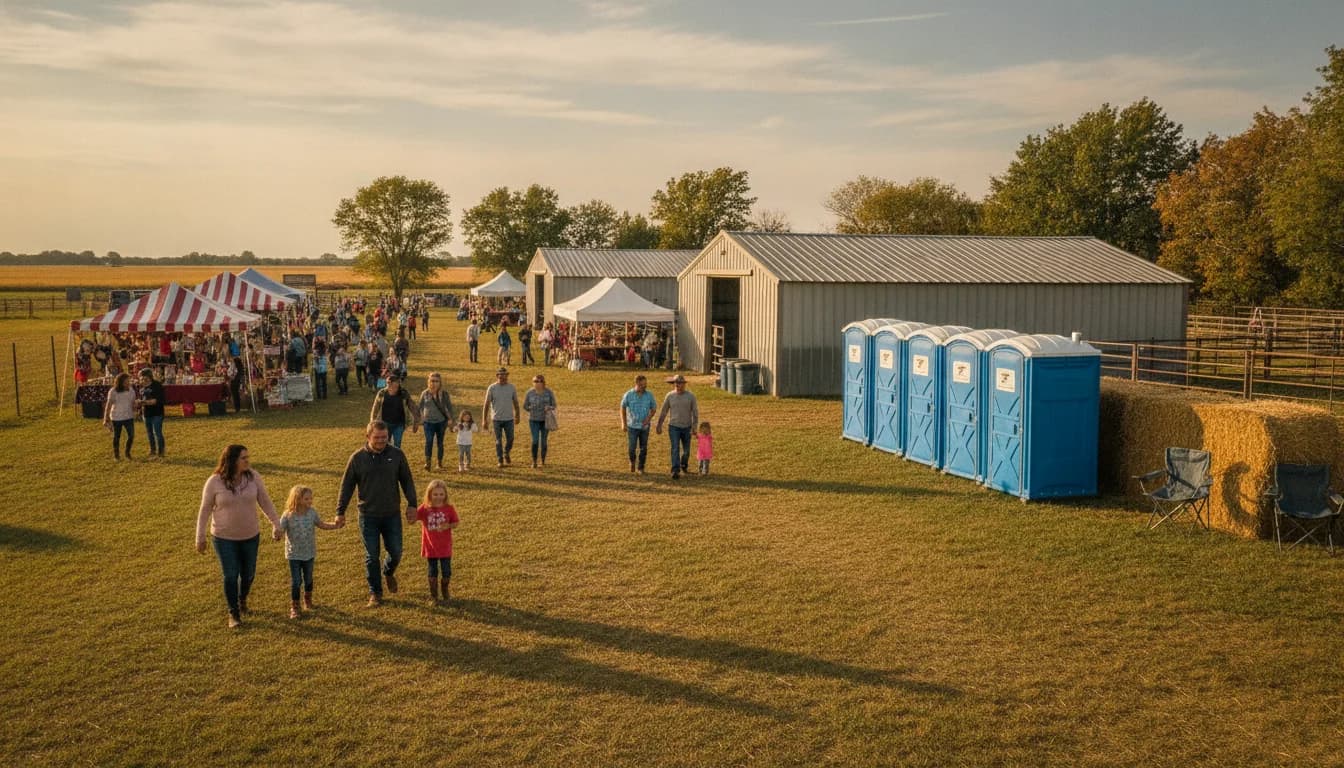
Here is the thing nobody tells you about planning a fall event in north-central Oklahoma: your event is not the only one. Between the first week of September and the end of October, this corner of the state runs a nearly unbroken chain of fairs, cook-offs, homecomings, harvest festivals, hunting camps, and weddings — and every one of them needs the same finite pile of blue units, trailers, and hand washing stations that sits in a yard in Newkirk.
Most people call about restrooms two to three weeks out, which is genuinely fine for most events on most weekends. The trouble is the weekends where it isn't, and there are several of those coming. This is a straight look at what the fall calendar around Kay County actually looks like, how far ahead you need to book for your specific kind of event, and the placement mistakes that only show up once the weather turns.
Quick Answer
For an ordinary fall Saturday, 4–6 weeks is comfortable. For an October wedding — the busiest wedding month in Oklahoma, on a date that cannot move — book 3–6 months ahead. For a multi-day festival or fair, or anything needing 10+ units, three to six months. Restroom trailers and ADA units are the first things to go, because every local operator owns only a handful. Short-notice premiums across the industry run roughly 20–35%, with weekend or same-day surcharges commonly $50–$150 on top — assuming the equipment exists at all.
Already have a fall date on the calendar?
Tell us the date, the headcount, and where you are. We'll tell you honestly what's still open — including if the answer is "not the trailer, but we can do units."
Check Availability →What the Fall Calendar Actually Looks Like Around Kay County
If you live here, none of these are news individually. Seeing them stacked on one page is the point — this is roughly six weeks of continuous demand, and it starts about three weeks from now.
- Kay County Free Fair— September 7–13 at the Blackwell Event Center & Fairgrounds. A full week of livestock shows, exhibits, and evening crowds, and the anchor of the local fall calendar.
- Cherokee Strip season in Ponca City — the Cherokee Strip Cook-Off at Lake Ponca in mid-September, a KCBS-sanctioned barbecue competition with vendors, live music, and family activities on the lake, plus the golf classic and the rest of the Cherokee Strip commemorations earlier in the month.
- Football and homecoming — Friday nights from late August onward, plus the tailgates, booster fundraisers, and alumni gatherings that ride along with them.
- Church and school fall festivals — the fall-festival and trunk-or-treat cluster through October, most of it outdoors on a parking lot or a field.
- Peak wedding season — October is when Oklahoma couples actually want to be outside: no 100° heat, no wind-driven spring storms. Barn venues, family land, and pasture ceremonies book out first.
- Hunting camps and lease season — dove opens September 1 and archery deer follows in October, which quietly puts a lot of people on remote ground for days at a time with no facilities within miles.
- Harvest and fall fieldwork — crews working long days a long way from a building, on the same weeks as everything above.
Notice what all of these have in common: fixed dates. A jobsite rental can start on Tuesday instead of Monday. A wedding cannot. Fair week cannot. That's the entire reason event restrooms have to be booked on a different timeline than anything else we rent.
How Far Ahead You Actually Need to Book
Search this question and you'll get advice ranging from "two weeks is plenty" to "twelve months for a popular Saturday," which is why nobody trusts any of it. Both are true for different events. Here's how we'd actually answer it for this area:
| Event type | Book this far ahead | Why |
|---|---|---|
| Backyard party, small fundraiser | 2–4 weeks | Standard units, flexible placement |
| Church or school fall festival | 4–6 weeks | Competes with every other October Saturday |
| Wedding (standard units) | 2–3 months | Immovable date, peak season |
| Wedding (restroom trailer) | 3–6 months | Very limited trailer inventory anywhere local |
| Multi-day festival, fair, rodeo | 3–6 months | Volume plus a mid-event servicing schedule |
| Hunting camp / lease | 3–4 weeks | Remote access needs planning, not inventory |
If you're reading this in mid-August, the practical translation is: September events should be booked now, October weddings should already have been booked and are worth calling about today, and anything in November has room to breathe.
What "Sold Out" Actually Means for a Local Operator
This is worth explaining plainly, because it's the part that makes national rental websites feel more reassuring than they deserve to be. Type your town into most of them and every date is available, every time. That's not confidence — it's that a lot of those sites are brokers who own no units. They take the booking first and go looking for someone with a truck second.
The failure mode is well documented and it is brutal: bookings confirmed months in advance, then cancelled days before the event as "outside the service area" — a fact that was equally true when the deposit was taken. One family described a wedding order originally around $340 that, after a last-minute cancellation, ended up costing them nearly triple to replace. If you want the longer version of how to spot this, our comparison of local versus national providers walks through the tells.
A real local company works the other way, and it's less flattering: we have a specific number of units, a specific number of ADA units, and a small number of trailers. A unit committed to the fairgrounds is a unit that isn't at your wedding. When we say a date is tight, it's arithmetic, not a sales tactic — and when we say yes, the equipment already exists and it's already ours.
Got a September date and no restrooms lined up?
Call and we'll check the actual yard, not a national availability screen. Brower Inc. is locally owned in Newkirk and covers 14 Oklahoma and 6 Kansas counties.
Call (580) 747-6206How Many Units a Fall Event Actually Needs
A working starting point, followed by the honest caveats:
- One unit per 50 attendees for a three- to four-hour event.
- Add 15–25%if you're serving alcohol.
- Add about one unit per hour beyond four hours.
- At least one ADA-accessible unit— and if you're only placing one unit somewhere, that one has to be the accessible one.
- A hand washing station per roughly four restrooms, and non-negotiably wherever food is served.
Two things change for fall events specifically. First, multi-day events are sized on peak simultaneous attendance, not on the weekend's total headcount — a fair that draws 4,000 people over a week might never have more than 600 on the grounds at once. Second, multi-day means servicing, not just delivery. The single most common complaint about festival restrooms anywhere is that they were fine on Friday and unusable by Saturday night. That's a servicing schedule problem, and it should be written into your quote before you sign anything.
On accessibility: Oklahoma has no single statewide event ratio. The requirements come from your city's special-event permit plus federal ADA obligations, and the published numbers around the state give a useful sense of the expectation — Tulsa and Oklahoma City both call for at least 10% of restroom facilities to be accessible, and Norman sets a 5% minimum. Check your specific city or venue, and walk the route: an accessible unit at the far end of a soft, sloping field isn't accessible. Our guide to ADA unit placement covers the surface and route requirements in more detail.
If your event is a wedding rather than a festival, the calculation shifts toward guest experience, and the standard-unit versus restroom-trailer comparison is the decision to make first, since it drives your lead time more than anything else. Venues with a couple of indoor bathrooms and a 200-person guest list have their own math, covered in our barn wedding restroom guide.
The Mistakes That Only Happen in the Fall
Summer events fail on heat and odor. Fall events fail on entirely different things, and they catch experienced organizers out because the weather is so pleasant right up until it isn't.
- The light goes early.A 6 p.m. October event that was comfortably lit in July is now finishing in the dark. Units placed at the dark end of a field stop getting used, and people start walking somewhere they shouldn't. Place them within reach of existing light or plan lighting for them.
- Soft ground, and this year especially.Kay County has had a genuinely wet 2026 — a top-five wettest June on record and a year-to-date well above normal, with the county at no drought classification at all in early August. Wet ground means two things: units need level, firm placement so they don't settle or tip, and our truck needs a route in that won't rut your pasture. Tell us about the gate and the approach when you book, not on delivery morning.
- Wind.Plains wind on an open fairground or a harvested field is the standard cause of tipped units, and it's worst on soft ground where anchoring is weakest. Placement against a treeline or a building beats the middle of an open field every time.
- The first cold snap. Late October can turn sharply. It rarely freezes hard enough this early to be a service problem, but it does change what guests will tolerate — a long walk to a unit at the edge of a dark, cold field is a very different ask in October than in June.
- Parking on the wrong ground. If your event is on a rural property with a septic system, keep vehicles off the drain field, and think about whether the house system can take the guest load at all — we wrote the math on that separately.
What to Have Ready When You Call
Five minutes of prep turns a vague quote into a firm one:
- The date, and the setup and teardown windows. "Delivered Friday morning, picked up Monday" is a different job than "delivered Saturday at 7 a.m."
- Peak simultaneous attendance, not total attendance — and be honest, since low-balling this is what creates lines.
- Hours, and whether alcohol is served.
- Whether it's a public event, which drives the accessibility requirement and possibly a city permit.
- The address, the gate, and the ground. Gravel drive, pasture, parking lot, locked gate, low branches — all of it matters for a truck that needs roughly 12 feet of overhead clearance and to park within about 25 feet of the placement spot.
- Whether you want a written all-in quote. You should. Ask for delivery, pickup, and any servicing to be named as line items, so the invoice matches the quote.
"Every September we get the same two phone calls. One is somebody who booked in July and just wants to confirm the delivery time. The other is somebody with an event on Saturday who just realized there's nowhere for 300 people to go. We do everything we can for the second call, and sometimes we pull it off. But the first call is a better way to live."
— Troy Brower, Owner | Brower Inc. | Newkirk, OK
How Brower Inc. Handles Fall Events
- Clean standard units placed where they're convenient without being the centerpiece of your photos.
- ADA-accessible units — which are also simply the easiest units for older guests and anyone in a dress.
- VIP restroom trailers for weddings and higher-end events — limited inventory, so this is the one to lock in early.
- Stocked hand washing stations wherever food is being served.
- Mid-event servicing on multi-day events, written into the quote so Saturday night doesn't undo Friday.
- Rural delivery that actually happens. Pasture gates, gravel section-line roads, and farm addresses are normal work here, not a reason to cancel two days out.
We serve Kay County including Ponca City and Blackwell, plus 13 more Oklahoma counties and 6 in southern Kansas. If your event date has already slipped past comfortable, our emergency deployment guide covers what's still possible on short notice.
Lock in your fall date before the calendar fills.
Tell us the date, the headcount, and the address, and we'll give you a written all-in quote with the servicing schedule named. Call (580) 747-6206 or request a quote.
Frequently Asked Questions
For an ordinary fall Saturday — a church gathering, a birthday, a small fundraiser — four to six weeks is comfortable and two weeks is usually workable. For a wedding on a set October date, book three to six months out; October is the busiest wedding month in Oklahoma and that date cannot move. For a multi-day festival, fair, or anything needing ten or more units, three to six months. The one week we'd genuinely warn you about in Kay County is fair week and the weekends on either side of it, when a large share of the local fleet is already committed. Published booking-window advice varies wildly between sources — some say two weeks, some say twelve months — because it depends almost entirely on how flexible your date is and how many units you need.
The Date Can't Move. The Booking Can.
Nearly every restroom disaster we hear about started as a scheduling problem rather than an equipment problem. The units existed. Somebody just asked for them the week the whole county was asking for them. If you have a September or October date on a calendar somewhere, the cheapest thing you will do all month is spend ten minutes now confirming that the restrooms are handled.
Brower Inc. is locally owned in Newkirk, answers its own phone, and has actual units in an actual yard. Call (580) 747-6206 or request a quote for your fall event.
Related reading
Related guides
Our services
Service areas