
Pump It in September, Not in January: The Fall Septic Window in North-Central Oklahoma
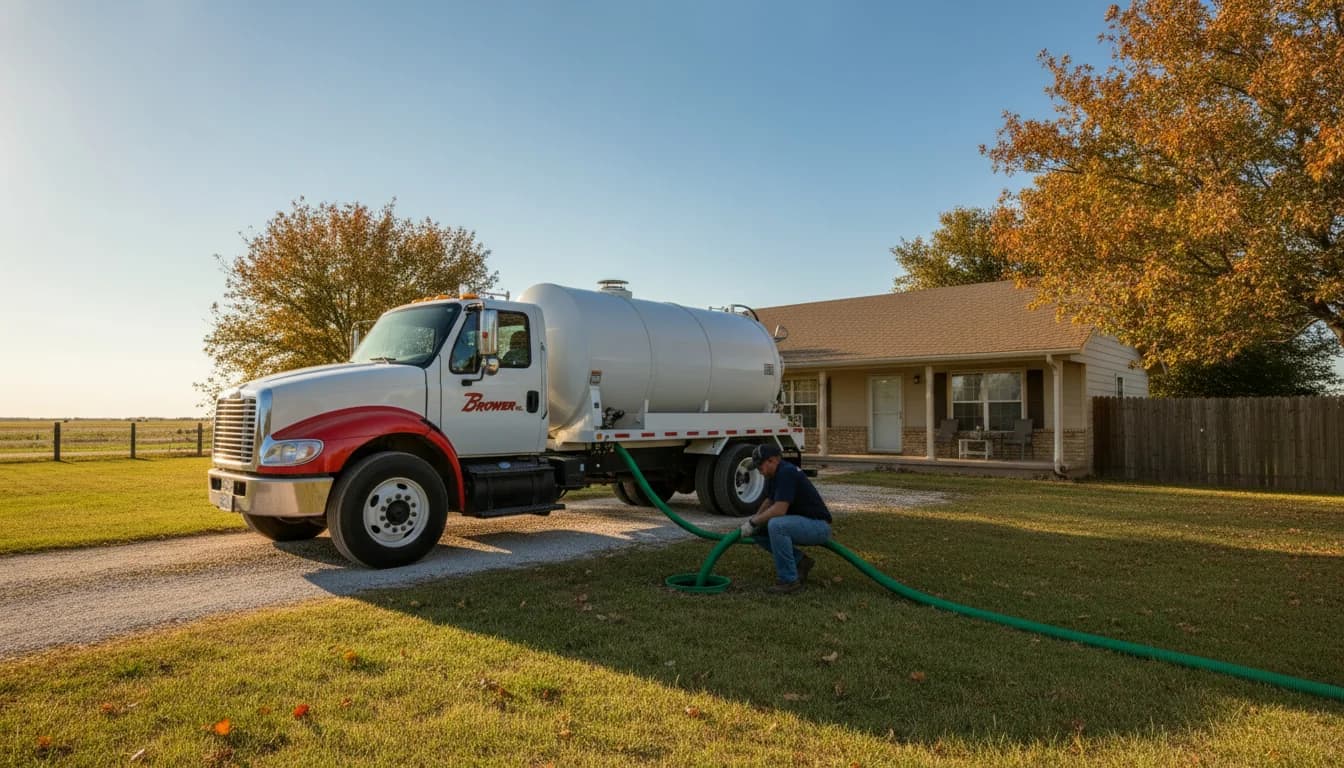
Every winter we take a version of the same phone call. It's the week of a holiday, the house is full, something has backed up, and the caller wants a truck out today. Then comes the part that makes it genuinely hard: the tank is a hundred yards off a dirt drive that's currently frozen ruts or soup, and a loaded vacuum truck weighs what a loaded vacuum truck weighs.
Almost every one of those calls was preventable six weeks earlier for a fraction of the cost and none of the stress. Nothing about a septic tank makes September special biologically — this is a logistics argument, not a science one. But in rural Kay County, logistics is most of the story. Here's how often you actually need to pump, why the stretch between now and the first freeze is the window, and what this unusually wet year changed.
Quick Answer
Pump a typical household septic tank every three to five years; EPA advises inspecting a system roughly every three years. The best time in north-central Oklahoma is the window between late summer and the first hard freeze — generally late October into November here — for three practical reasons: the truck can still reach the tank, you enter the heavy-use holiday stretch with full capacity, and any problem the inspection finds becomes a scheduled repair instead of a January emergency. One more thing specific to this year: Kay County came off a top-five wettest June on record with no drought classification at all in early August, so drain fields have less absorption margin in reserve than usual.
Don't know when yours was last pumped?
That's the most common answer we get, and it's reason enough to get it opened and looked at. Brower Inc. is a DEQ-licensed pumper based in Newkirk.
See Septic Pumping →How Often You Actually Need to Pump
The standard answer is every three to five years, and EPA's guidance is to have the system inspected about every three years with pumping on roughly that cycle. That range is useful but it hides a lot of variation, and the variation is mostly about the ratio between tank size and household size:
| Situation | Practical interval |
|---|---|
| 1–2 people, 1,000+ gallon tank | Toward the 5-year end, sometimes longer |
| 3–5 people, 1,000-gallon tank | Every 3 years is the honest number |
| Large household, laundry-heavy, or a garbage disposal | Every 2–3 years |
| Aerobic system with spray or drip field | On its own service schedule — see below |
| "The previous owners handled that" | Due now |
Two local factors push these intervals shorter rather than longer. The first is clay. Dense clay soils are common across Kay County and the surrounding counties, and clay percolates poorly, which means a drain field here is working with less headroom than the same field would have on sandy ground. Keeping solids out of it — which is exactly what pumping does — is the cheapest protection available. The second is simply age: many rural systems around here are older than the people currently living on top of them.
If you have an aerobic system, the schedule is different and so are the rules — Oklahoma requires a free two-year maintenance period from the installer, and our guide to aerobic systems in Oklahoma covers what ongoing service should look like after that.
Why Fall Is the Window — Three Practical Reasons
To be clear about what this claim is and isn't: a septic tank doesn't know what month it is, and pumping in April is not somehow worse for the biology. The case for fall is entirely about access, capacity, and timing of repairs.
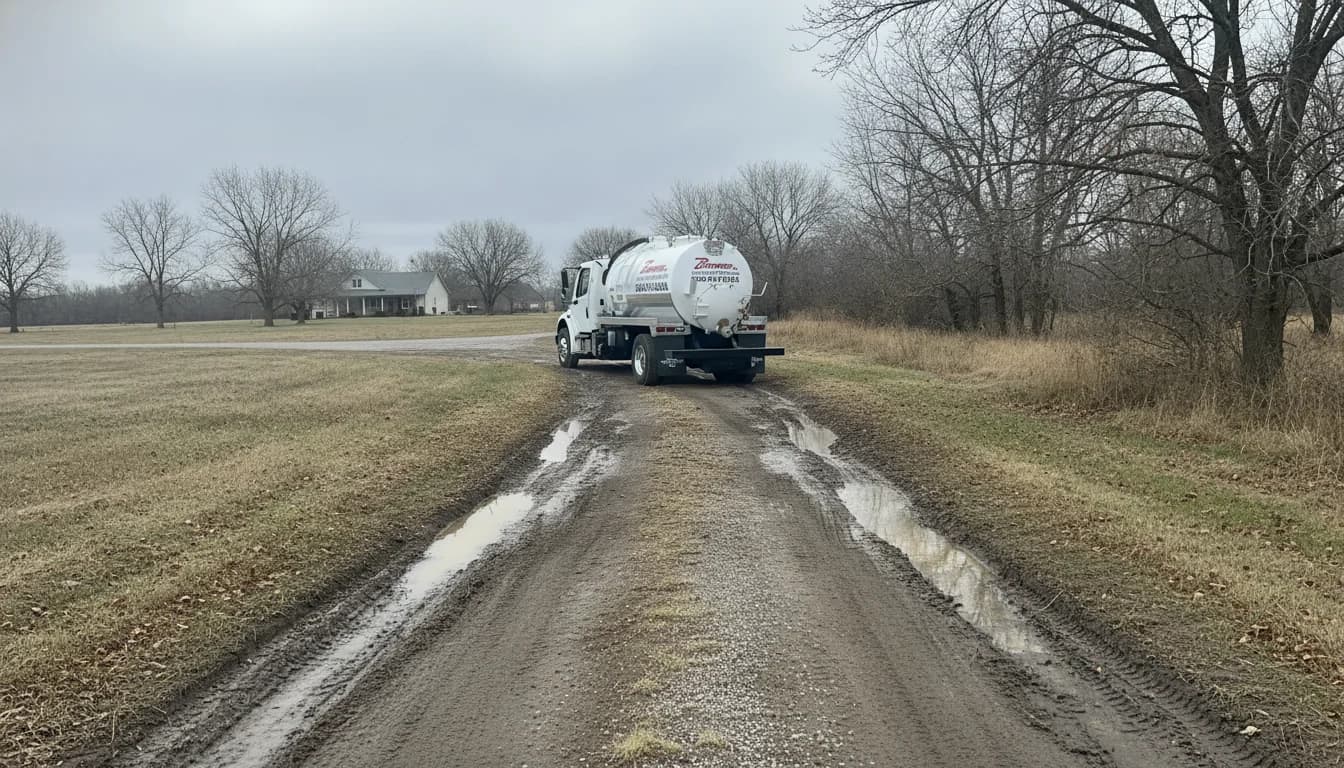
- The truck can still get to the tank.This is the big one out here and it's the one nobody thinks about until it matters. A pump truck needs a firm route to within hose reach of the lid. In September that's a gravel drive. In February it can be frozen ruts, standing water, or mud deep enough that bringing a heavy truck up it damages your drive and risks getting stuck. Frozen ground also makes locating and opening a buried access lid genuinely difficult.
- You go into the heaviest-use season with full capacity.Household water use climbs from Thanksgiving through New Year: guests staying over, extra laundry, dishes for twelve. A tank that's already thick with sludge has less liquid working volume and less settling time exactly when you're asking the most of it. Pumping first is the difference between a system with margin and one running at its limit through the busiest six weeks of its year.
- Problems found in October are repairs; problems found in January are emergencies. A pump-out is also the only time anyone actually looks inside the tank. If a baffle has failed, if the outlet is partially blocked, or if the field is struggling, you want to learn that on a mild Tuesday with time to get a quote — not at 9 p.m. on a holiday with a full house and freezing rain.
There's a useful national marker for this too: EPA's SepticSmart Week runs September 14–18, 2026. It exists precisely because fall is when the agency wants homeowners thinking about maintenance rather than reacting to failures.
What Waiting Until Winter Actually Costs
The price difference between a scheduled pump and an emergency one is real, but it's the smaller half of the cost. The larger half is what a winter failure does to everything around it.
- Emergency call-out versus scheduled service. Routine pumping is a planned job on a planned route. An emergency is a truck rerouted at short notice, often on a weekend or a holiday — that's the version with a premium attached. Our Oklahoma septic pumping cost guide lays out the normal numbers.
- Frozen lines. The pipe from the house to the tank, and on aerobic systems the spray heads, can freeze during a hard Oklahoma cold snap — and a tank overdue for pumping is working with less liquid volume and thus less thermal buffer than a healthy one.
- Damage to your own property.A heavy truck on a soft or thawing rural drive can leave ruts you'll be fixing in the spring. That's not a bill from us — it's just a cost.
- The backup itself.Sewage in the house during a holiday is the outcome everything above is designed to avoid, and it's the one with cleanup costs that dwarf the pumping bill.
- Drain field damage that outlasts the winter.The expensive failure isn't the tank — it's solids reaching the field and clogging the soil. Replacement runs from a few thousand dollars into the five figures on heavy clay.
Get on the fall schedule while it's still routine.
DEQ-licensed pumping across 14 Oklahoma and 6 Kansas counties, including the gravel-road addresses other outfits would rather not visit.
Call (580) 747-6206What a Wet 2026 Changed Around Here
This is worth a section on its own because it's specific to this year and this county, and because it cuts against the usual assumption that dry weather is the thing to worry about.
Kay County has been notably wet in 2026. June came in around the fifth wettest on record over 132 years, several inches above normal, and the year to date has run well above normal too. As of the U.S. Drought Monitor reading in early August, the county sat at zero percent drought and zero percent abnormally dry — no drought stress at all, which is not how most Oklahoma summers read.
For pastures that's good news. For a drain field it's a reason to pay attention. A drain field disposes of effluent by letting it soak into surrounding soil, and soil that's already near saturation has less capacity to accept more. That's the mechanism behind the familiar pattern where backups and surfacing effluent show up after a heavy rain rather than during a dry spell. Add dense clay, which drains slowly to begin with, and a system that coped fine through a dry year can be closer to its limit than the owner realizes.
None of that means your system is failing. It means the margin is thinner, and the sensible response is to spend the fall reducing load on the field — which is exactly what pumping the tank does.
Signs You Shouldn't Wait Until Spring
If any of these are already true, going into winter as-is is the bet we'd advise against:
- Slow drains across the whole house — not one fixture, which is a plumbing problem, but everything at once.
- Gurgling from toilets or drains when other water is running.
- Soggy ground or unusually green grass over the drain field, which can mean effluent is surfacing instead of soaking in.
- Sewage odor indoors or out over the yard.
- Any backup into the house, ever, even once.
Each of these is covered in more depth in our guide to septic warning signs, and if the answer to "when was it last pumped" is "more than a decade ago," we wrote a whole piece on where you actually stand. Worth knowing on the regulatory side: Oklahoma DEQ requires that effluent not surface, pool, or flow across the ground, so surfacing sewage is a compliance matter as well as a repair.
"The January calls are the ones I hate. Somebody's got family in from out of state, the tank's backing up, and I'm looking at a quarter mile of drive I can't put a loaded truck on without tearing it up. Same job in September is an hour and a normal bill. It's the same tank. It's just a completely different day."
— Troy Brower, Owner | Brower Inc. | Newkirk, OK
How Brower Inc. Handles Fall Pumping
- DEQ-licensed septic tank pumping on a scheduled route, so it's a planned job at a planned price.
- An actual look inside while the lid is open — baffles, outlet, sludge depth, and an honest read on the field.
- Rural access as normal work.Section-line roads, long gravel drives, and farm addresses are what we do; we'd simply rather drive them in October than in February.
- A straight answer on urgency.If your tank has two more good years in it, we'll tell you that. Talking people into unnecessary work is how the outfits everyone complains about operate.
- Portable restrooms if the repair runs long, so a household isn't stranded while a system is opened up — one call covers both sides.
We cover Kay County and 13 more Oklahoma counties plus 6 in southern Kansas. For the full year-round picture, our Oklahoma septic maintenance guide covers what to do between pump-outs, and if you're hosting over the holidays, the math on guest load is the companion piece to this one.
Get it pumped while the driveway still cooperates.
Tell us roughly when it was last done and where you are, and we'll get you on the fall schedule at a normal price. Call (580) 747-6206 or request a quote.
Frequently Asked Questions
The widely accepted guidance is every three to five years for a typical household, and EPA recommends having a system inspected roughly every three years with the tank pumped on that same general cycle. The honest version is that the interval depends on your tank size, how many people live in the house, and how much water you use — a 1,000-gallon tank serving five people needs pumping far more often than the same tank serving two. In this part of Oklahoma there's an additional factor: dense clay soils mean a drain field has less margin for error, so keeping solids out of it by pumping on schedule matters more here than it would on sandy ground. If you genuinely don't know when it was last pumped, treat it as due now.
Same Job. Six Weeks Earlier.
There's no clever trick in any of this. The tank you pump in late September is the same tank you'd pump in January. The difference is that in September the truck gets there easily, the inspection findings are something you can plan around, and you go into the holidays with room to spare instead of hoping. In January it's a bad day for everyone, and it costs more.
Brower Inc. is locally owned in Newkirk, DEQ-licensed, and handles both septic service and portable restrooms across north-central Oklahoma and south-central Kansas. Call (580) 747-6206 or request a quote.
Related reading
Related guides
Our services
Service areas